Crate Training for Dogs: Step-by-Step Guide for Calm, Safe Crate Use
If you’ve just brought home a puppy, adopted a rescue dog, or you’re simply tired of coming home to chewed-up shoes, chances are someone has already told you to “just crate train him.” It’s advice that gets repeated so often it almost sounds like a cliché — but the truth is, most people who try crate training and give up aren’t doing anything wrong with the idea. They’re doing something wrong with the process. They rush it, they use the crate as a punishment when the dog does something wrong, or they leave a crying puppy in there for hours hoping he’ll “get used to it.”
Done properly, crate training isn’t about confinement at all. It’s about giving your dog a space that feels like his own — a den, a retreat, a place where nothing bad ever happens to him. Done well, most dogs actually choose to nap in their crate long after training is finished, door wide open, because it has become the most reliably calm spot in the house.
This guide explains how to introduce a crate with rewards, choose an appropriate size, build short, comfortable sessions, and recognize signs that the dog needs a slower pace. Sample routines are illustrations, not a medically validated day-by-day training schedule. If your dog becomes distressed or has separation-related problems, ask a veterinarian or suitably qualified behavior professional for individual guidance.
Why Crate Training Works: The Science Behind the “Den” Instinct
Dogs are descended from den-dwelling ancestors, and while a modern house dog obviously isn’t living in the wild, that instinct for a small, enclosed, defensible space hasn’t disappeared. A crate that’s introduced correctly taps into that same instinct: it becomes a compact, secure spot where your dog can switch off and rest without needing to monitor the whole house.
Veterinary and animal-welfare organizations generally support crate use when it’s implemented well. Companion animal care guidance from groups like the American Veterinary Medical Association centers on the idea that housing needs to give an animal a secure, comfortable place to rest, and a properly sized, properly introduced crate fits that description. National welfare organizations that work with shelter and rescue dogs, including the Humane Society, have also pointed to crates as a legitimate tool for building a sense of security — while cautioning, correctly, that a crate is not a fix for behavior problems on its own and should never be used as a form of punishment.
That last point matters more than almost anything else in this guide. A crate used correctly is neutral-to-positive: dogs walk in on their own, get rewarded, and feel safe. A crate used as a punishment — tossing your dog in and slamming the door because he chewed something — teaches him to associate the crate with your anger, not with safety. Once that association forms, undoing it takes far longer than building it right the first time would have.
What Crate Training Actually Solves
Before getting into the how-to, it helps to be clear on what a crate is genuinely useful for, because that shapes how you’ll use it once training is done:
- Housetraining. Dogs instinctively avoid soiling the space where they sleep, so a properly sized crate speeds up potty training dramatically when paired with a consistent bathroom schedule.
- Safety when unsupervised. A crate prevents a young or newly adopted dog from chewing electrical cords, ingesting something toxic, or getting into a fight with another household pet while you’re not there to intervene.
- Travel. Crates that meet transport standards are required for flying with a dog in cargo, and a travel-safe crate secured in a car is one of the few restraint methods proven to protect a dog in a collision.
- Recovery and vet visits. Dogs recovering from surgery are frequently required to rest in a confined space to avoid reinjuring themselves, and a dog who’s already comfortable in a crate handles that recovery period with far less stress.
- A personal retreat. Even dogs who are never crated overnight often benefit from having “their” space — somewhere children and guests know to leave alone, and somewhere the dog can go voluntarily when the house gets loud or overwhelming.
Choosing the Right Crate: Types and Sizing
Getting the crate itself right is half the battle. A crate that’s the wrong size, the wrong style for your dog’s temperament, or placed in the wrong spot in the house will fight against everything you’re trying to teach.
Crate Types
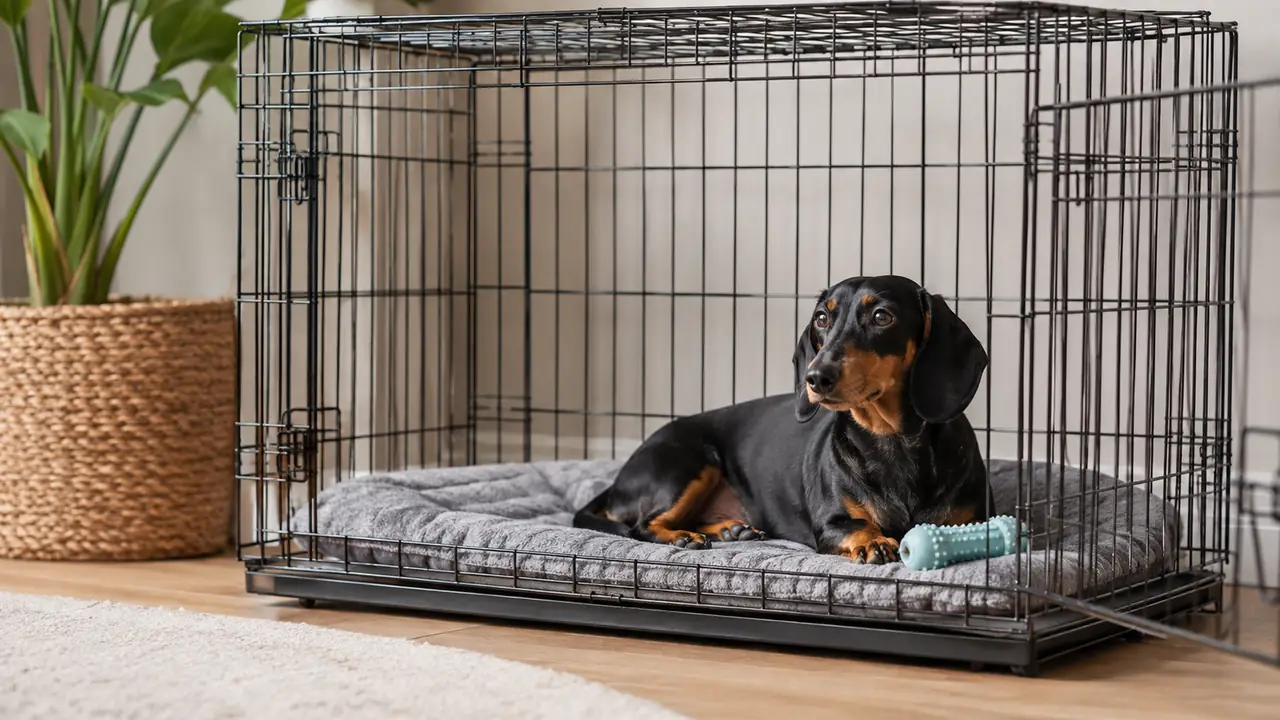
Wire crates are the most common choice for home use. They fold flat, offer excellent airflow, and let your dog see the room around him, which some dogs find reassuring and others find overstimulating. Covering three sides with a light blanket can turn an overstimulating wire crate into a much calmer one.
Plastic (travel) crates are enclosed on three sides with a door on the front, which makes them feel more den-like and tends to suit anxious dogs or dogs who get overstimulated by an open view of the room. They’re also the standard style required for airline travel.
Soft-sided crates are lightweight and portable, ideal for calm, already-trained dogs on trips or at outdoor events, but they’re not appropriate for a dog who chews, scratches, or hasn’t finished training — a determined dog can tear through the fabric.
Furniture-style crates, built to look like an end table or bench, are a good option once training is complete and you want the crate to blend into a living space, but they’re not usually the best choice to start training in, since access for teaching and observing your dog is more limited.
Sizing: Measure the Dog, Not the Breed Chart
The most common mistake in crate selection isn’t the type — it’s the size. A crate should be large enough that your dog can stand up fully without ducking his head, turn around in a complete circle, and lie flat on his side with his legs extended. It should not be significantly larger than that.
An oversized crate defeats the purpose for housetraining specifically, because a puppy will simply use one corner as a bathroom and sleep in the other, undermining the instinct not to soil the sleeping area that makes crate-based housetraining work in the first place. If you’re crate training a puppy who still has a lot of growing to do, the better solution is a crate with a removable divider panel, so you can buy one crate sized for the adult dog and section it down while he’s small, moving the divider back as he grows.
As a rough starting point by adult weight (always confirm against your specific dog’s measurements, since body shape varies a lot within these ranges):
| Dog’s Approximate Adult Weight | Typical Crate Length |
|---|---|
| Under 25 lbs (e.g., Chihuahua, small terriers) | 18–24 inches |
| 25–40 lbs (e.g., Beagle, Cocker Spaniel) | 24–30 inches |
| 40–70 lbs (e.g., Border Collie, Labrador) | 30–36 inches |
| 70–90 lbs (e.g., German Shepherd) | 36–42 inches |
| 90+ lbs (e.g., Great Dane, Mastiff) | 42–48 inches |
If your dog falls between sizes, size up rather than down, and rely on a divider panel to remove excess space rather than cramming a growing dog into a crate that will be too small in a few months.
Where to Put the Crate
Location matters more than most people expect. For the first few weeks, the crate should be in a room where the family spends time — a living room or bedroom — rather than an isolated laundry room or garage. Dogs are social animals, and a crate placed somewhere isolated reads less like “my safe den” and more like “the place I get sent away to.” For overnight training, especially with puppies, keeping the crate in or near your bedroom for the first couple of weeks measurably reduces nighttime crying, since the puppy can hear and smell you nearby rather than feeling completely alone in a new environment.
The One Rule That Makes or Breaks Crate Training
Before the step-by-step process, there’s a single principle worth repeating on its own: the crate is never used as punishment, and your dog should never be forced or dragged into it. Every single interaction with the crate during training should end with the dog feeling like something good just happened — a treat, a favorite chew toy, a calm word. If your dog associates the crate with being in trouble even once during the early training period, you’ll likely need to spend real time rebuilding trust before training can move forward again.
Step-by-Step Crate Training Process
This process works for puppies and can be adapted for adult dogs and rescues (see the section on adult dogs below for what changes). Go at your dog’s pace rather than the calendar’s — a confident puppy might move through these steps in three or four days, while an anxious rescue dog might need two or three weeks on the early steps alone. Rushing is the single most common reason crate training fails.
Step 1: Introduce the Crate With the Door Open
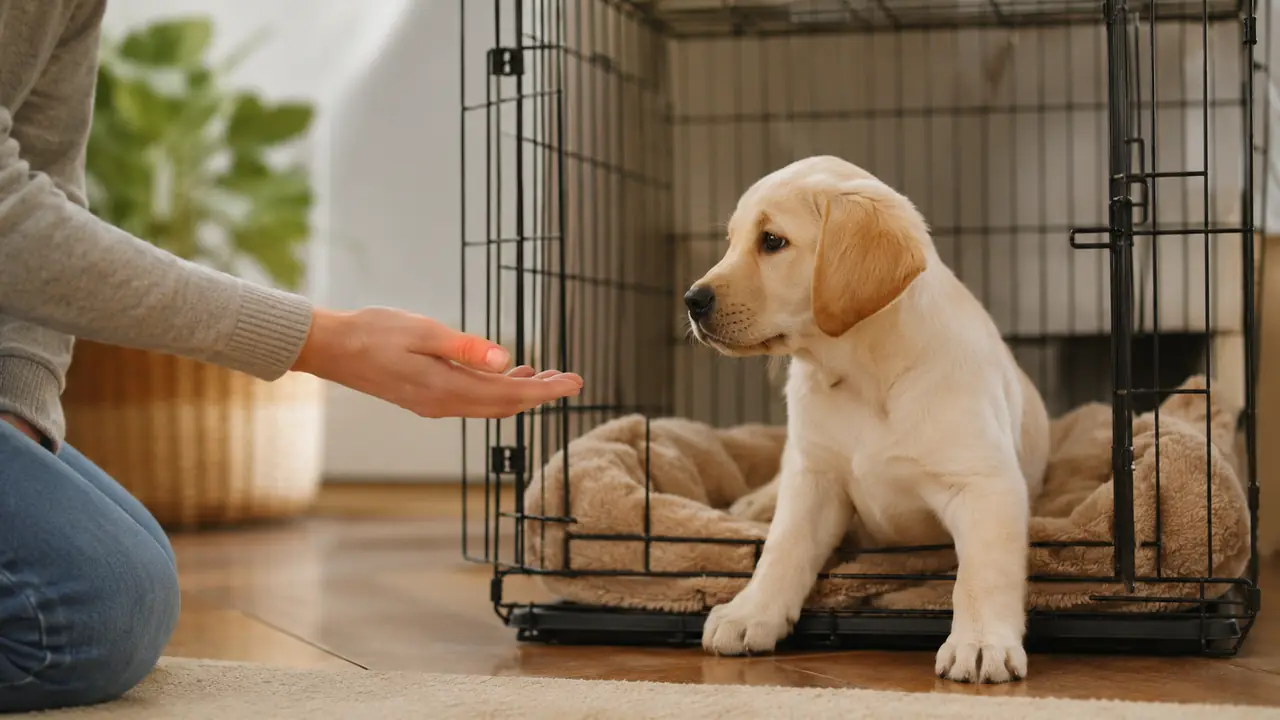
Set the crate up in a common living area with the door propped open and a soft bed or blanket inside. Don’t force your dog toward it — instead, toss a few treats near the entrance, then a few just inside, then a few further in, letting your dog choose to explore at his own pace. Some dogs walk right in on day one; others need a few days of treats simply appearing near the crate before they’re comfortable approaching it. Either is normal.
During this stage, you can also start pairing a verbal cue with the crate — “crate,” “kennel,” or “bed” — said calmly each time your dog walks in, so the word starts to carry a positive association before you ever ask for anything more from him.
Step 2: Feed Meals in the Crate
Once your dog will walk in for a treat, start feeding regular meals just inside the crate entrance, with the door left open the entire time. Over a few days, move the food bowl progressively further back into the crate until your dog is walking all the way in and eating comfortably with his whole body inside. This step alone does an enormous amount of the emotional work of crate training, since it directly links “inside the crate” with one of the most rewarding parts of a dog’s day.
Once your dog eats calmly with his whole body inside the crate, you can begin closing the door partway during meals — just for a few seconds at first — opening it again as soon as he finishes, before working up to closing it fully for the length of the meal and then reopening it right away.
Step 3: Short, Closed-Door Sessions While You’re Home
With meals going smoothly, start closing the door for short sessions outside of mealtimes. Give a treat as your dog enters, close the door, sit nearby for a few minutes, then open the door and let him out — calmly, without a big celebration that might teach him that getting out of the crate is the exciting part.
Increase these sessions gradually, and vary the duration rather than increasing it in a straight line — a few seconds, then back down, then a bit longer, then briefly shorter again. This variable pattern (rather than a steady, predictable climb) prevents your dog from learning to anticipate exactly when the door will open, which is part of what keeps early crate anxiety from building.
Step 4: Practice Leaving the Room
Once your dog is settling calmly for a few minutes with the door closed and you sitting nearby, start stepping a few feet away, then out of sight for a few seconds, then briefly into another room. Return before your dog has a chance to become distressed, and keep sessions short enough that success is easy. A stuffed chew toy or long-lasting treat given right as you leave gives your dog something engaging to focus on besides your absence, and is one of the most effective tools in this entire process.
Gradually extend how long you’re out of sight and how far you go — to another room, then downstairs, then briefly outside — always returning calmly rather than rushing back the moment you hear any noise, unless your dog is showing genuine distress rather than mild protest (more on telling the two apart below).
Step 5: Extend to Real-World Durations
By this stage, you can begin leaving the house for genuinely useful stretches of time — first short errands, then longer outings — while your dog is crated. Continue to keep departures and returns low-key: no dramatic goodbyes, no dramatic greetings. Calm entrances and exits reinforce that being crated is simply a normal, unremarkable part of the day rather than a big event worth getting worked up about.
Step 6: Overnight Crate Training
Nighttime is usually the hardest transition, particularly for puppies who aren’t used to being separated from their mother and littermates. Take your puppy out for a last bathroom break right before bed, and place the crate near your bed for at least the first couple of weeks so your puppy can hear and smell you. Expect one or two overnight wake-ups for a bathroom break with a young puppy — set an alarm based on his age-appropriate bladder capacity (see the table below) rather than waiting for crying to wake you, since a puppy who’s woken you by crying has already learned that crying works.
As your puppy grows and demonstrates he can reliably hold his bladder overnight, you can gradually move the crate to its permanent location, if that’s different from your bedroom.
Consider a dog who will readily take a treat at the crate entrance but backs away when a person reaches for the door. That is not a reason to hurry to the next step. For several sessions, keep the door secured open, reward approaching and entering, and let the dog leave voluntarily. Only when entry looks relaxed should a hand move the door a little; open it again immediately before signs of concern appear. The dog's body language determines the pace, not the calendar. In the same household, another dog might lie inside with the door closed after a short introduction. Those different timelines are both acceptable.
The aim is to build a predictable resting location, not to teach helplessness. Quiet can mean comfortable sleep, but it can also accompany fear or shutdown. Look for loose muscles, ordinary breathing, a willingness to enter again and the ability to settle after the door opens. If the dog repeatedly refuses food, drools, pants heavily, claws at the bars, injures itself or attempts frantic escape, stop the confinement exercise and consult a veterinary professional or qualified reward-based behavior specialist.
Age-Based Bladder Capacity and Crate Duration
Puppies genuinely cannot hold their bladder as long as adult dogs, and crating a puppy beyond his physical capacity doesn’t teach patience — it just forces him to soil the crate, which undermines the entire housetraining process and can make him less bothered by a dirty crate over time. Use this as a general planning reference, adjusting for your individual puppy:
| Age | Daytime Crate Duration | Overnight (typical) |
|---|---|---|
| 8–10 weeks | 30–60 minutes at a time | 3–4 hours |
| 10–12 weeks | 1–2 hours | 4–5 hours |
| 3 months | 2–3 hours | 5–6 hours |
| 4 months | 3–4 hours | 6–7 hours |
| 5–6 months | 4–5 hours | 7–8 hours |
| 6+ months | Up to 6 hours | Varies, often a full night |
A widely used rule of thumb for daytime hours is your puppy’s age in months plus one — so a three-month-old puppy can typically be expected to hold it for around four hours during the day, though individual dogs vary and some need more frequent breaks than this suggests.
Crate time should be built up gradually through positive, voluntary sessions, not used as punishment. PDSA and Blue Cross advise that dogs should not be confined in a crate for more than three hours at a time, and some dogs tolerate much less. Dogs need appropriate breaks, movement, water and interaction; if your schedule exceeds what your dog can manage comfortably, arrange another safe care option. Dogs showing distress need an individualized plan rather than longer forced confinement.
Age-based charts are planning aids, not guaranteed limits. A very young puppy, a dog on medication, an older dog with urinary disease or a dog with digestive upset may need toileting opportunities far sooner than a chart predicts. Arrange the schedule around waking, meals, drinking and activity, and allow easy access to an appropriate toilet area. Punishing an accident after prolonged confinement is unfair and teaches nothing useful. If house soiling begins suddenly in a previously reliable adult, medical assessment belongs ahead of more restrictive confinement.
A Sample Daily Schedule (8–16 Week Old Puppy)
Structure helps enormously with crate training, because a predictable routine makes it far easier for your puppy to learn when to expect a bathroom break, when to expect play, and when it’s time to settle down. Here’s a realistic sample for a young puppy — adjust the actual clock times to fit your household, but keep the pattern of frequent, predictable transitions:
| Time | Activity |
|---|---|
| 6:30 AM | Out of crate, straight outside for a bathroom break |
| 6:45 AM | Breakfast, then short supervised playtime |
| 7:30 AM | Bathroom break, then crate nap |
| 9:30 AM | Bathroom break, training or play session |
| 10:30 AM | Bathroom break, crate nap |
| 12:00 PM | Bathroom break, lunch, play |
| 1:00 PM | Bathroom break, crate nap |
| 3:00 PM | Bathroom break, play or training |
| 5:00 PM | Bathroom break, dinner |
| 6:00 PM | Family time, supervised free time in the house |
| 8:30 PM | Bathroom break, wind-down time |
| 9:30 PM | Last bathroom break, into crate for the night |
The specific hours matter far less than the rhythm: a bathroom break every time your puppy comes out of the crate, and every time he wakes up, finishes eating, drinks water, or plays hard.
Troubleshooting Common Crate Training Problems
“My dog cries or barks every time I close the door”
Some protest in the first few sessions is normal and usually settles within five to ten minutes as your dog realizes nothing bad is happening. The key is not to let your dog out while he’s crying — that teaches him that crying gets the door open, which is one of the fastest ways to create a much bigger, longer-lasting crying habit. Instead, wait for even a brief pause in the noise, then open the door calmly. If you’ve moved through the steps too quickly, it often helps to go back a stage — shorter sessions, more treats, more time with the door open before challenging your dog again.
Genuine panic looks different from ordinary protest, though, and it’s worth learning to tell the two apart. A dog who settles within a few minutes, who eats and drinks normally, and who’s generally a calm, secure personality outside the crate is very likely just protesting mildly. A dog who is drooling excessively, panting heavily, scrabbling at the crate door hard enough to injure himself, or who refuses to eat or drink even highly desirable treats near the crate may be showing genuine anxiety rather than simple frustration, and pushing forward with the same plan usually makes that worse rather than better.
“My dog seems to have real separation anxiety, not just crate dislike”
True separation anxiety is a specific, diagnosable condition, not simply a dog who’d rather not be alone — and it’s important not to assume every crying puppy has it. Signs that point toward genuine separation anxiety rather than ordinary crate protest include: panic that doesn’t settle even after 20–30 minutes, self-injury from trying to escape, and anxious behavior that happens even when the dog is loose in the house rather than crated, as soon as you’re out of sight or preparing to leave. If this describes your dog, a crate can actually make the anxiety worse rather than better, because it removes the option to pace or seek you out. This is a situation where it’s worth talking to your veterinarian or a certified dog behaviorist before continuing with standard crate training, since treatment for genuine separation anxiety often involves a different approach entirely, sometimes including behavioral medication alongside training.
“My dog refuses to go anywhere near the crate”
Go back to square one and slow down further than you think you need to. Move the crate to a busier part of the house if it’s currently somewhere isolated. Try scattering high-value treats — small pieces of chicken or cheese rather than regular training treats — leading up to and just inside the entrance, without any expectation that your dog goes further than he’s comfortable with on a given day. For some dogs, removing the door entirely for the first week or two (so there’s no possibility of ever feeling “trapped”) makes a meaningful difference, with the door reattached only once the dog is voluntarily napping inside.
“My puppy is fine at night but panics when I leave for work”
This usually means the association-building steps were rushed, particularly Step 4 — the gradual practice of leaving the room and then the house. Go back to short, low-stakes departures: step outside for thirty seconds, come back in calmly, and build the duration back up from there rather than jumping straight to a full workday.
“The crate works but my dog whines the second he wakes up from a nap”
This is often less about the crate and more about needing a bathroom break, food, or company, and it usually resolves once you respond consistently to the first quiet moment rather than the loudest crying — letting your dog out during a pause reinforces calm behavior rather than noise.
Crate Training Adult Dogs and Rescues
Everything above works for adult dogs too, with a few adjustments. Adult dogs, especially rescues, often arrive with an unknown history — some have never seen a crate, some had positive experiences with one at a previous home, and some associate crates with a shelter environment or a prior owner who used one as punishment. Because you don’t know which of these you’re working with, it’s worth treating every adult dog as if he’s starting from zero, moving through the same open-door, meal-feeding, short-session steps rather than assuming he’ll adapt instantly.
Adult dogs typically move through the early stages faster than puppies simply because they have more impulse control, but they can also be more set in their ways if they’ve developed a negative association already. Patience during the first week matters more than speed for these dogs. It’s also worth noting that many well-adjusted adult dogs never need to be crated at all once they’re house trained and trustworthy alone — for these dogs, crate training is less about daily confinement and more about having the option available for travel, vet stays, or recovery periods when it’s genuinely needed.
Crate Accessories Worth Having
A few extras make the whole process smoother, and none of them are strictly required — but they solve predictable problems before they start:
- A properly sized bed or mat. Skip anything with loose stuffing for puppies who are still teething, since a torn-open bed becomes both a mess and a swallowing hazard. A firm, chew-resistant pad is the safer choice until you know your dog won’t destroy soft bedding.
- A water source for longer stretches. A bowl that clips to the crate wall avoids spills that a loose bowl on the floor of the crate almost guarantees.
- Long-lasting chews or food puzzles. Reserved specifically for crate time, these help your dog build a positive, engaged association with being inside rather than simply waiting out the clock.
- A breathable cover. Particularly useful for wire crates in a busy, high-traffic part of the house, to cut down on visual stimulation without cutting off airflow.
- A crate that matches your dog’s chewing habits. Dogs who are heavy chewers or determined escape artists may need a heavy-gauge wire or reinforced plastic crate rather than a lightweight wire model, since a bent or broken latch is both a safety issue and a training setback.
Crate Training in a Multi-Dog Household
Households with more than one dog need a slightly different approach, mainly because dogs learn a lot by watching each other — which can work in your favor or against you. A new puppy who watches an older, crate-comfortable dog walk calmly into his own crate for a treat often picks up the behavior faster than he would in a single-dog home, simply by observing that nothing bad happens.
The complication is that each dog needs his own crate, sized for his own body, and each dog’s training needs to be reinforced individually rather than assuming that group exposure alone is enough. Feed each dog in his own separate crate from the start, even if they’re comfortable eating near each other outside of training, since resource-guarding around food is more likely to develop in a crate’s confined space than in an open room. It’s also worth crating dogs separately during the actual “alone time” stages of training (Steps 4 and 5 above), so that each dog learns to settle independently rather than only tolerating the crate because a housemate is nearby — that way, if one dog ever needs to travel, recover from surgery, or stay somewhere without the other, he already has practice being calm on his own.
Signs Your Dog Is Ready to Graduate From Full-Time Crating
Not every dog needs to be crated for life, and recognizing when your dog is ready for more freedom is as much a part of good crate training as the initial process. Generally, a dog is ready to spend more unsupervised time loose in the house once he’s been reliably house trained for at least a few consistent months, hasn’t shown destructive chewing on furniture or belongings during supervised free time, and doesn’t get into unsafe items like trash, cords, or houseplants when left to explore on his own.
The safest way to test this is gradually rather than all at once: start by leaving your dog loose in a single, dog-proofed room for short outings, then extend the duration, then extend the space, always returning to check for any problems before pushing further. If something goes wrong at any stage — an accident, a chewed cushion, obvious anxiety — it isn’t a failure, just useful information that your dog needs a bit more time before that level of freedom. Many owners find their dog continues to nap in his open crate voluntarily long after he’s earned full run of the house, simply because the space still feels like his.
Common Mistakes That Undermine Crate Training
- Using the crate for punishment. Even once, this can set training back weeks.
- Crate too large. Undermines housetraining and removes the “den” feeling that makes a crate work.
- Moving too fast. Skipping ahead to long sessions or overnight crating before your dog is ready is the single most common cause of crate anxiety.
- Letting your dog out while crying. Reinforces noise as the way to get the door open.
- Inconsistent use. Crating only occasionally, or letting family members break the rules (“just this once”), slows progress and confuses your dog about what to expect.
- No exercise or mental stimulation beforehand. A dog crated after a long walk and a training session settles far more easily than one crated with pent-up energy.
- Isolating the crate in a separate room permanently. Especially early on, this can make the crate feel like exile rather than a den.
Frequently Asked Questions
How long does crate training take? There’s no fixed timeline — a confident puppy might be comfortable with several hours in the crate within a week or two, while an anxious rescue dog might take a month or more to build the same trust. Progress at the pace your individual dog sets, not a fixed calendar.
Is it cruel to crate a dog? Not when it’s introduced gradually, sized correctly, and never used as punishment. Major veterinary and welfare organizations broadly support crate use under these conditions, while cautioning that a crate isn’t a substitute for adequate exercise, attention, or training, and shouldn’t be used to isolate a dog for excessive stretches of time.
Should I cover the crate at night? Many dogs settle better with a light cover over a wire crate, since it blocks visual stimulation and creates a more den-like feel — just make sure airflow isn’t restricted and the fabric is something your dog can’t pull in and chew.
Can I crate train a dog with severe anxiety? Sometimes, but it needs a slower, more careful approach than standard training, and in more severe cases, working with your veterinarian or a certified behaviorist first is the safer route rather than pushing forward alone.
Do I need to crate my dog forever? No. Many owners phase out regular crate use once a dog is fully house trained and reliably well-behaved unsupervised, transitioning instead to a gated area or free run of the house, while keeping the crate available (door open) as a resting spot and for travel or vet visits.
What size crate does a puppy need if he’s still growing? Buy for your dog’s expected adult size and use a removable divider panel to shrink the usable space while he’s small, moving the divider back every few weeks as he grows. This avoids the cost and hassle of buying multiple crates and keeps the space appropriately snug for housetraining at every stage.
Is it okay to leave toys in the crate overnight? Soft toys with stuffing or squeakers are best kept for supervised playtime rather than overnight crating, since an unsupervised puppy can tear one apart and swallow pieces. A single firm, appropriately sized chew is generally the safer overnight option.
My dog is completely silent in the crate but seems flat and withdrawn — is that a good sign? Not necessarily. Quiet isn’t always calm. A dog who seems shut down, avoids eye contact, or won’t engage with treats even after settling in may be shutting down out of stress rather than relaxing, and this is worth mentioning to your veterinarian rather than assuming training is going well simply because there’s no barking.
The Bottom Line
Crate training works because it respects how dogs actually think, rather than fighting against it. Move at your dog’s pace, keep every interaction with the crate positive, size the crate correctly, and follow a schedule that matches your dog’s real physical capacity rather than your convenience. Rushing any of these steps is almost always the reason crate training fails — and slowing down is almost always the fix. Given enough patience, most dogs end up seeing the crate not as confinement, but as the one place in the house that’s entirely, reliably, calmly their own — a habit that tends to last for the rest of their lives, long after the formal training itself is finished.
The best measure of crate-training success is that the dog sees the space as a safe option and can rest without distress. That does not mean every dog must sleep in a crate. Some do better with an open bed, a puppy-proofed room or a gate that offers more choice. The ASPCA notes that a crate may help certain dogs, while making separation-related anxiety worse for others; a panicking animal needs assessment and a different plan, not longer forced confinement. For daily life, prioritize comfort, supervision, exercise, social contact and a humane alternative when confinement does not suit the individual.
Sources and further reading (editorial references; not a veterinary endorsement): ASPCA — Separation Anxiety and Crate Distress · AVSAB — Humane Training and Trainer Selection