Dog Training at Home: A Simple Daily Routine for Beginners
You do not need an hour-long formal training block to teach a well-mannered dog. Home training works best when small lessons are attached to routines that already happen: meals, doors, walks, play, settling in the evening, grooming, and visitors. Five minutes repeated several times a day gives the dog far more useful practice than one exhausting weekend session.
A beginner plan should prioritize behaviors that make everyday life safer: attention to name, recall, loose leash, wait, leave it, drop, place/settle, cooperative handling, and calm greetings. Tricks are welcome, but household safety skills come first.
Set Up a Training Zone
Begin in a quiet room with good footing, a few tiny treats, a toy if useful, and minimal distraction. The goal is fast success. Once a skill is fluent, move it to kitchens, hallways, yards, sidewalks, and gradually harder environments.
A useful training space is not necessarily a special room. The best starting point is somewhere your dog can notice you, move comfortably, and make a correct choice without competing with constant noise. Remove toys that repeatedly steal attention, put treats where you can reach them without fumbling, and choose non-slip flooring. If other pets become excited by training, work one animal at a time behind a safe barrier. A dog who cannot focus because a child is racing past or someone is preparing dinner is not failing the lesson; the setup is doing too much of the work against them. A few calm successes in an ordinary hallway are worth more than a dramatic session in a crowded park.
Plan where the reward will come from and where the dog will go after a success. For a mat lesson, keep the mat visible and reward on it. For recall, start only a short distance away and pay the dog close to your legs so returning fully is worthwhile. Place your phone somewhere you can record a ten-second clip if you need to understand an awkward movement, but do not allow filming to turn the exercise into a performance. One person should give cues while the other observes. After a few repetitions, take a break and ask whether the dog is eager to return to the space voluntarily. That willingness is useful feedback about difficulty and comfort.
Teach a Marker
Choose a clicker or a short word such as “yes.” Mark the instant the dog performs the correct action, then deliver the reward. A marker separates the exact behavior from the few seconds it may take to reach the treat.
The marker should tell the dog exactly which action earned the reward. Begin with a handful of easy repetitions: say “yes” once, then give a small treat. Do this when the dog is comfortable and not already scrambling for food. Next, wait for something simple, such as a glance toward you or all four paws standing on the floor, and say the word at that moment. Your reward follows immediately. The sound matters less than its reliability. If three family members use “yes” for completely different events, the signal becomes confusing. Agree on a word, practice your own timing, and keep ordinary conversation distinct from training.
A marker does not replace an actual reward, and it cannot rescue an unclear exercise. If the dog sits and rises again before you mark, you may be rewarding the stand instead of the sit. Slow down the setup so the intended action is easy to see. You can practice without your dog by dropping a coin and saying the word precisely when it touches the floor. When you train, avoid repeating a cue several times before the animal responds. Give one clear opportunity, make the task easier if necessary, and reward success. Gradually the marker helps you become more precise and lets the dog understand why a small behavior was worth repeating.
Morning: Name Response and Check-In
Say the dog’s name once when success is likely. Mark and reward orientation toward you. On walks, reinforce spontaneous check-ins so attention becomes a habit rather than something you demand only when a problem appears.
Start in the morning when the dog is awake but not desperate to get outside. Say the name once in a friendly voice, mark the instant the head turns, and reward near your body. Then allow the dog to look around again. Repeat a few times, never so often that the name becomes background noise. Calling the dog's name should not predict something unpleasant, such as an abrupt end to play or being scolded. If the response has already become unreliable, practice at a quieter distance or use a fresh attention cue with a consistent reward history. The purpose is orientation, not demanding that a dog stare continuously at its owner.
During a short walk, look for voluntary check-ins rather than commanding attention every few seconds. Reward when the dog glances back without being pulled. A dog who can freely sniff and then return attention often learns a more practical habit than a dog forced to maintain an unnatural heel for the entire outing. If your dog ignores you when another animal appears, that observation tells you the situation may be too difficult. Turn away and begin at a greater distance next time. For an easily startled dog, noticing the trigger and choosing to follow you away is a valuable skill. Build it gradually rather than waiting until the dog has already lunged.
Before Meals: Sit, Wait and Release
Use the food bowl to practice impulse control without turning meals into a long obedience exam. Ask for one easy behavior, lower the bowl, pause briefly, and release. Build duration gradually and avoid repeatedly teasing the dog with food.
Mealtimes offer a predictable opportunity to practice one modest behavior, but food should never become a tool for prolonged frustration. Ask for an easy sit if the dog can do so comfortably, lower the bowl a little, and reward a brief pause. Give a consistent release word so the dog understands when the meal is available. Initially that pause may be a single second. Increase difficulty only when the dog is relaxed. If your dog has joint pain, chooses to stand, or becomes distressed, a calm stand may be more appropriate than insisting on a sit. Training should adapt to the dog rather than making access to necessary food conditional on physical discomfort.
Avoid teasing by repeatedly lifting food away after the dog has succeeded. That can increase excitement and make a simple routine harder than it needs to be. If a puppy jumps, try preparing meals behind a gate and returning only when the movement settles. With multiple dogs, feed separately where necessary to prevent competition. Do not use this exercise as treatment for food guarding; a dog stiffening over a bowl or growling when approached needs a safety-focused plan and qualified help. The goal is a polite, predictable moment at mealtime, not a test of obedience performed under pressure.
Doorways: Wait and Permission
Teach the dog that doors open for calm behavior. Use a leash initially, crack the door, close it if the dog surges, and reward waiting. Release deliberately. This is especially valuable at front doors, car doors, and gates.
A doorway is a real safety problem because one sudden movement can put a dog in traffic, a stairwell, or an unfamiliar corridor. Begin at a low-risk interior door with the dog on a comfortable leash. Touch the handle, then reward the dog for remaining near you. Open the door a small amount and close it gently if the dog surges forward; there is no reason to jerk the leash or scold. Gradually increase how widely the door opens, then give a release cue that means movement is permitted. If your dog struggles, return to the smaller door movement that was previously easy. Keep the session brief enough that waiting remains understandable.
Practice the same routine at a car door and a garden gate only after the indoor version is fluent. Physical management should stay in place even when the cue seems reliable: hold the leash, secure outer doors, and warn visitors not to leave gates ajar. If a dog is frightened by a noisy corridor or strongly drawn to passing animals, work farther from the trigger rather than repeatedly opening the door into an overwhelming situation. A trained wait is an extra layer of safety, not an alternative to an appropriate barrier. Reward the dog for choosing to stay connected with you when access to the other side is exciting.
Walks: Loose Leash in Tiny Sections
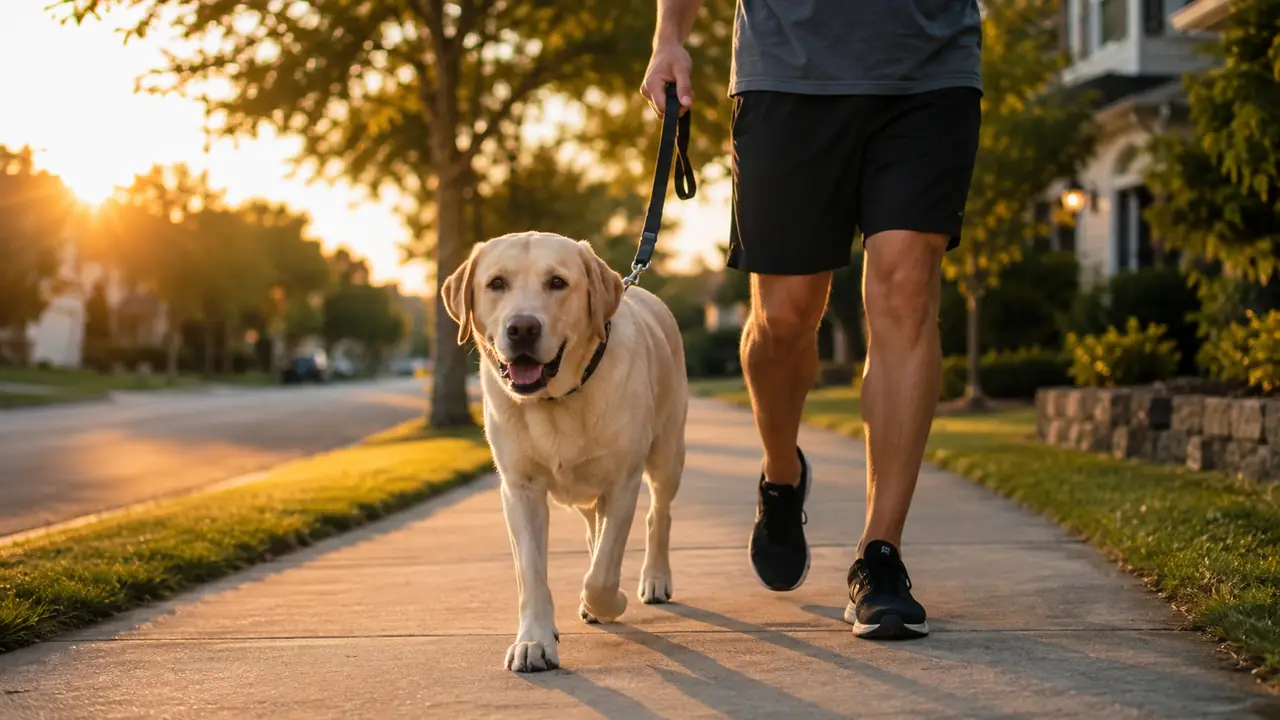
Reward the dog near you before pulling begins. If the leash becomes tight, stop or change direction rather than allowing pulling to consistently reach the reward. Give sniff breaks on cue so the walk includes dog needs as well as handler control.
Teach the first few steps where the dog can succeed, perhaps indoors or at the quiet end of the driveway. Start moving and reward when the leash stays loose. Keep treats near the leg rather than throwing them ahead; this makes returning toward you worthwhile. If the leash tightens, pause or change direction calmly and wait for slack before resuming. Punitive collar corrections are unnecessary and can add fear or pain. Choose comfortable, well-fitted equipment and allow sniffing breaks because exploration is a legitimate part of the walk. The objective is a dog who can travel without constant tension, not a head fixed at your knee for thirty minutes.
Suppose your dog walks nicely for six steps and then pulls toward a tree. That is your current difficulty level. Reward the first few loose steps, release the dog to sniff when it is safe, and begin another short section. Gradually build the distance instead of insisting on perfect behavior for a whole block. If barking and lunging around traffic or other dogs are also present, address trigger distance and emotional safety as separate issues; loose-leash technique alone will not resolve fear or intense excitement. A short route that ends with several calm repetitions may be more useful than a long route in which everyone struggles.
Midday: Recall Games
Practice short recalls between family members, from one room to another, or on a long line outside. Reward generously and release the dog back to fun often so coming to you does not always end freedom.
Recall becomes dependable when returning to you has a history of good outcomes. Begin by calling the dog from a short distance inside the home, marking the movement toward you, and rewarding generously when the dog reaches you. Use one consistent cue and avoid calling repeatedly while the dog ignores it. To build enthusiasm, have another household member reward the dog, then take a turn yourself. Keep movement playful and let the dog return to ordinary activity afterward. If every recall ends the enjoyable part of the day, the cue becomes less appealing. Sometimes reward, praise, and then tell the dog it may continue sniffing or playing.
Outdoors, use a long line in a safe area while distractions are still manageable. Never treat recall practice as permission to experiment with freedom beside roads, livestock or wildlife. Start at a distance where the dog notices a distraction but can still respond. If the dog cannot turn back, shorten the distance, reduce the challenge, and rebuild success. A frightened dog, a scent-driven dog and a young puppy may need quite different levels of support. For emergencies, physical management remains essential. An enthusiastic indoor recall is an excellent beginning, but reliability across environments takes repeated, carefully planned experience.
Afternoon: Leave It and Drop
Teach leave it with safe low-value items and reward disengagement. Teach drop by trading for something better, then often return the original safe object. These cues reduce conflict around stolen items and dangerous finds.
“Leave it” means choosing not to take an item; “drop” means releasing something already held. They are related but should be taught separately. For leave it, place a low-value object where the dog cannot grab it, wait for a moment of disengagement, mark that choice and reward from your other hand. As the response improves, practice with the object more visible, then with safe household temptations. Do not begin with dangerous food or medication. For drop, offer a safe toy, present a better reward, mark the release, and often return the toy after the trade. Returning it sometimes helps the cue avoid becoming a signal that possessions always disappear.
If a dog guards food or stolen objects, do not reach into its mouth or corner it in an attempt to demonstrate authority. People can be bitten when an animal feels trapped. Manage access to dangerous objects in advance and work with a qualified behavior professional when guarding or growling is present. In daily life, calmly traded toys and small rewards teach cooperation. Practice when nothing important is at stake so the dog has a familiar option when a real mistake occurs. A reliable cue is built with ordinary, low-pressure repetitions; it is not invented in the moment a puppy runs off with a sharp object.
Evening: Place and Settle
Reward the dog for lying on a mat, then gradually build duration while normal household activity continues. Calm is a trained skill, especially for adolescent or highly active dogs.
A mat can provide a predictable resting spot while dinner is prepared or visitors are seated. Begin by rewarding any voluntary step toward the mat, then the act of putting paws on it. When the dog lies down comfortably, reward on the mat and add a quiet release cue after a short pause. Gradually extend the time between rewards while the room remains calm. You can scatter a few pieces of the dog's normal ration or offer an appropriate chew if your veterinarian has no dietary concerns. The exercise should teach genuine relaxation, not the suppression of movement by constant corrections. An exhausted, frightened dog is not necessarily settled simply because it is silent.
Next, introduce ordinary household events in small doses: a person standing, a cupboard opening, or a chair sliding. If the dog repeatedly leaves, the challenge is too great; reduce the distraction and reward an easier success. Some dogs cannot settle when they are hungry, overtired or anxious, so review the whole daily routine rather than adding more commands. Allowing rest and choice is part of the lesson. For dogs who growl when people approach their bed, avoid turning the mat into a location where humans repeatedly force interaction. Choose a safe place and get specialist advice about guarding or fear.
Handling: One Minute Every Day
Touch paws, ears, collar, mouth area, and body briefly while pairing with rewards, staying within the dog’s comfort. Cooperative handling makes grooming and veterinary care dramatically easier over time.
Cooperative handling starts with consent-like signals: the dog approaches voluntarily, presents a paw, or rests its chin on a hand or towel for a moment. Touch one easy body area, reward, and stop before discomfort appears. Build toward ears, paws, collar and mouth area through brief, predictable practice. If the animal turns away, stiffens, licks its lips repeatedly or tries to leave, make the task easier. For a fearful rescue dog, simply approaching a grooming brush may be enough for the first sessions. A person who waits for the dog to participate can often build a more stable routine than someone who tries to finish a whole nail trim in one confrontation.
Do not attempt painful manipulations at home under the banner of training. Ear infections, sore teeth and injured paws require veterinary attention, and sedation or professionally guided handling may be appropriate for necessary care. Practice holding the collar gently before you need it, but do not use a collar grab to surprise or punish the dog. Pair handling with reliable rewards and end sessions while the animal remains comfortable. This approach has value beyond grooming: it can make future physical examinations and routine treatments easier and safer for the dog and the people providing care.
Generalize One Skill at a Time
Do not assume “sit” learned in the living room exists at the park. Lower criteria in new places. Add distraction, distance, and duration separately rather than all at once.
Dogs do not automatically understand that a cue learned beside the kitchen counter should mean the same thing beside a busy road. Generalization takes deliberate practice. First repeat the familiar behavior in a second quiet room, then at the doorway, then outside when little else is happening. Reward generously whenever the surroundings change. Keep the difficulty dimensions separate: add distance or duration or distraction, rather than asking for all three at once. A dog who sits reliably for five seconds in the hallway may struggle with just one second beside a barking neighbor's dog. That is not defiance; the environment has changed the task.
Keep each new location safe enough for failure. A recall should be practiced on a line rather than next to a road, and a door wait should use a physical barrier until reliable. If performance drops, describe exactly what changed: the floor surface, the time of day, the proximity of children, or the scent of another animal. That information helps you choose a manageable next attempt. When you reward the easier version again, you are not losing progress; you are helping the dog connect the same cue with a more complicated world. Good training is often a series of small successes in many places.
Track Progress With Behavior, Not Perfection
A useful log says “three successful recalls on a 15-foot line near mild distraction,” not “training was good.” Objective notes reveal where the dog is ready to progress and where the environment is still too difficult.
A training diary does not need to be formal. Write down the cue practiced, the location, the number of opportunities and how many responses occurred without repeated prompting. Record the level of distraction and whether the dog looked relaxed or distressed. For example, “returned four times on a long line from a calm garden distance; needed one extra prompt when a bird moved nearby” is more informative than “recall still bad.” After a week you can see what is improving and where the dog is still confused. Keep a note of sleep, pain or unusual events if they coincide with a sudden loss of concentration.
Avoid selecting goals solely because they look impressive on a social-media video. A dog who can return away from a dropped snack, accept paw handling comfortably, and rest peacefully during dinner may have learned more important life skills than a dog who performs a dozen flashy tricks under pressure. Reward small improvements, maintain safety measures and take breaks when either learner becomes frustrated. If fear, aggression, separation distress or a sudden behavioral change is driving the problem, involve a veterinarian or a qualified humane trainer rather than intensifying a homemade program. Progress means better daily functioning and welfare, not a perfect score.
Common Mistakes to Avoid
- Training only after bad behavior occurs
- Making sessions too long
- Repeating cues many times
- Moving to high-distraction places too soon
- Using every recall to end fun
- Skipping calm/settle work
- Allowing different family members to use contradictory rules
The first mistake is expecting a dog to succeed in an environment where the lesson has never been practiced. Calling once beside a quiet sofa and expecting the same recall beside running children are very different challenges. The second is inadvertently paying the wrong moment: reaching for a treat while the dog is jumping, or releasing through a doorway just after a forward surge, may reward the behavior you hoped to reduce. Slow your movements, make the timing clear, and adjust the setting so a correct response is easy to produce.
A further mistake is using harshness when a dog is afraid or confused. The American Veterinary Society of Animal Behavior recommends reward-based training and opposes aversive approaches. If an animal growls, panics, shuts down or is in physical discomfort, punishment can make the situation less safe. Another common problem is letting every family member invent different cue words and rules. Pick a few important behaviors, agree on consistent signals, and let rewards and gradual practice do the teaching. A realistic, kind routine followed by the whole household is more effective than an elaborate plan nobody can maintain.
A Practical Decision Checklist
- Marker is consistent
- Rewards are tiny and ready
- Sessions under five minutes when possible
- Daily routine contains several practice moments
- Distractions increase gradually
- Recall is rewarded generously
- Calm behavior is trained
- Household cues match
Before beginning, ask five questions. Is the behavior safe to practice here? Does the dog understand what action earns a reward? Can the dog succeed with the present level of distraction? Is the reward meaningful enough for this setting? Is anyone likely to use a different cue or accidentally reinforce the unwanted response? If any answer is uncertain, simplify the exercise. For a puppy, that might mean returning indoors. For an anxious dog, it may mean increasing distance. For a dog that appears sore, it means postponing training until discomfort has been assessed.
At the end of a session, check whether the dog was willing to re-engage, whether movement and breathing looked normal, and whether the next step is really necessary today. Record one practical outcome such as a calmer door opening or two confident recalls. Keep equipment comfortable and rewards appropriate to medical diets and daily calorie needs. If you are not sure whether a problem is primarily fear, pain or learned behavior, avoid guessing about causes and ask for professional evaluation. These choices build a program that is sustainable in everyday family life rather than dependent on one successful demonstration.
Frequently Asked Questions
How many minutes a day should I train? Several short sessions totaling 15–30 minutes across the day can be plenty for a beginner, especially when real-life practice is counted.
Which command should I teach first? Name response, recall, and a simple position such as sit are useful starts, but management and a calm routine matter at the same time.
What if my dog is not food motivated? Try training before meals, use play or access rewards, test different safe foods, and consider stress or illness if the dog refuses normally valued rewards.
Can I train two dogs together? Teach new skills individually first. Later practice together once each dog understands the behavior and can work around the other.
Should I use a clicker? Optional. A clear marker word can work very well if timing is precise.
Why does my dog forget commands outside? The environment is harder. Rebuild the skill with more distance from distractions and better reinforcement.
When do I need a professional trainer? Whenever you want coaching, and early for fear, aggression, biting, severe reactivity, or behavior that creates safety risk.
The Bottom Line
Home training becomes easy to sustain when it is woven into the day. Reward attention, practice around doors and meals, build recall, teach safe object skills, reinforce calm, and spend one minute on handling. Small repetitions in real contexts create behavior that actually works outside a training session.
Successful home training happens in ordinary moments: a dog turns at its name, waits while a gate is opened, drops a safe toy for a trade, or settles on a mat while the household is busy. Each behavior is small, but together they make daily life calmer and safer. Build them with clear cues, rewards, manageable distractions and freedom to take breaks. Do not use a timetable as a measure of worth; an older dog, a nervous rescue and an energetic puppy will learn at different speeds. When training seems stalled, change the conditions rather than increasing pressure.
A good program is one the dog can live with. Keep the most important safety management in place, celebrate reliable behavior in real situations and ask for veterinary or qualified behavior support when fear or illness is involved. For further reading, the American Veterinary Society of Animal Behavior publishes humane-training and trainer-selection position statements. Those resources can help owners evaluate advice critically without treating social-media success stories as evidence that one harsh or rapid method will work for every dog.
Sources and further reading (not a claim of veterinary review): AVSAB — Humane Dog Training and How to Choose a Trainer · ASPCA — Separation Anxiety and Fear-Based Behavior