Rainy Day Dog Activities: Indoor Exercise and Enrichment Ideas
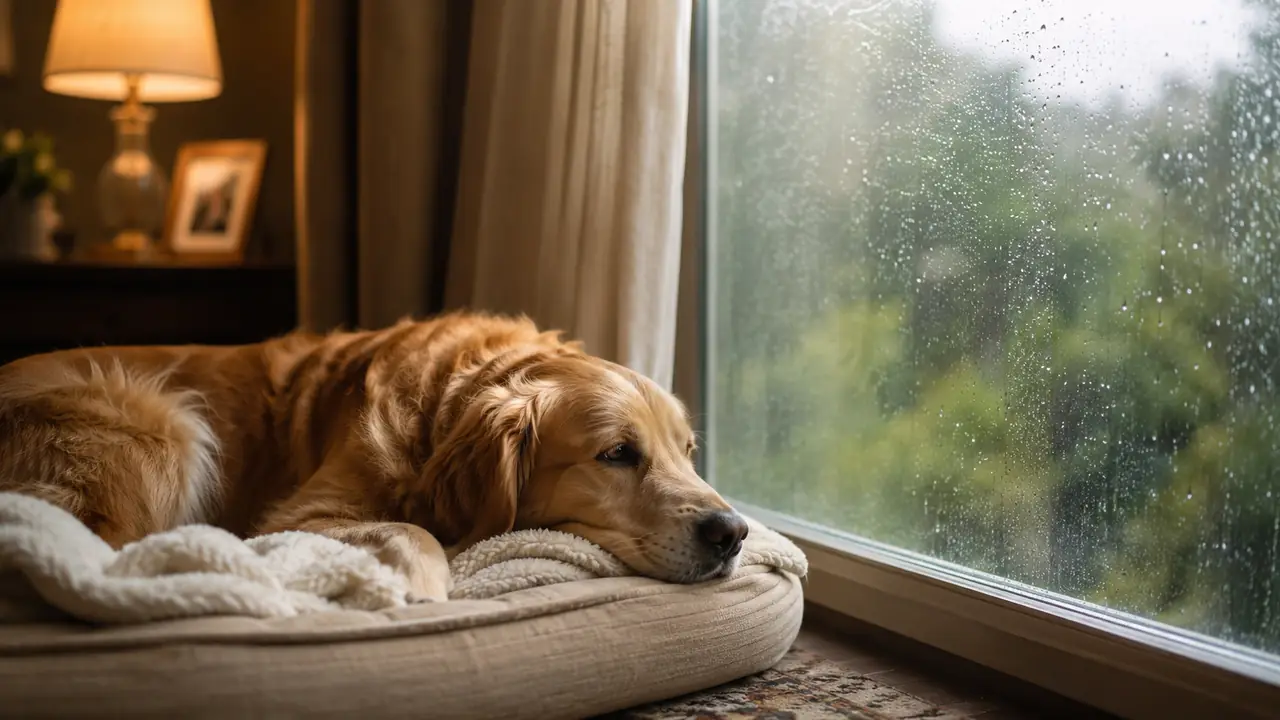
A rainy day does not need to become a no-activity day. When normal walks are shorter or unsafe, dogs can still use their noses, solve simple problems, practice useful skills, move safely indoors, take bathroom breaks, and get the rest they need. The key is replacing part of the outdoor routine—not trying to exhaust the dog inside.
Updated August 13, 2026 · Veterinary enrichment and safety sources checked
Age, breed type, health, mobility, fitness, weather conditions and your dog's normal activity level should determine how much indoor or outdoor activity is appropriate.
Rain changes more than the walking route.
Outdoor time may become shorter. Sniffing opportunities change. The ground becomes slippery. Paws and coats come home wet. Some dogs dislike the sound or feel of rain, while others would happily stay outside in it all day.
A good rainy-day plan does not simply cancel everything.
It asks which needs still have to be met and which activities can be safely moved indoors.
The goal is not to keep the dog entertained every minute.
Dogs also need calm periods and sleep.
The most useful rainy-day routine usually combines brief outdoor needs, appropriate indoor movement, mental enrichment, social interaction, reward-based training and normal rest.
Quick Answer: What Can You Do With a Dog on a Rainy Day?
Use short scent searches, food puzzles, hide-and-seek, reward-based trick training, controlled tug, simple recalls, toy searches, mat training and other low-risk indoor activities.
Use secure rugs or another nonslip surface for activities that involve movement, especially for puppies, senior dogs and dogs with mobility problems.
Outdoor walks can still be appropriate in ordinary light rain when the route and dog are comfortable, but shorten or replace them when there is lightning, flooding, unsafe footing, severe wind, extreme cold, significant fear or another hazard.
After wet outings, dry the dog according to coat type and pay particular attention to paws, skin folds and areas where moisture remains trapped.
Do not try to compensate for one missed long walk with uncontrolled indoor running on slippery floors.
A Balanced Rainy Day Has More Than Exercise
In This Rainy Day Dog Activities Guide
1. Many Dogs Can Still Walk in Ordinary Rain
Rain alone does not automatically mean a dog must stay indoors.
A healthy dog that is comfortable in mild wet weather may still enjoy a normal or shortened walk.
Instead of using a blanket rule, assess the actual conditions.
Ask:
- Is the rain mild or severe?
- Is there lightning or dangerous wind?
- Is the route flooded?
- Is footing slippery?
- Is visibility poor?
- Is the dog comfortable?
- Can the dog be dried appropriately afterward?
A shorter sniff-focused outing may be more useful than forcing the usual distance when conditions are unpleasant.
Back to guide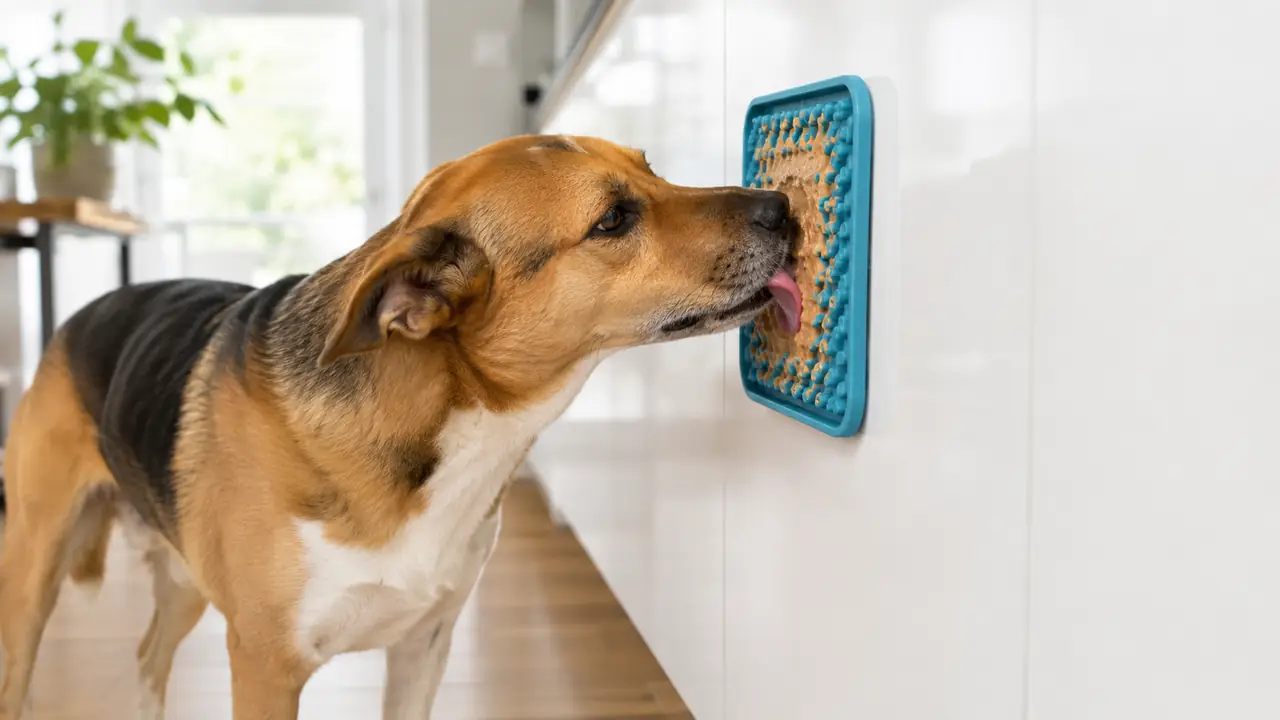
2. Some Weather Conditions Should Change the Outdoor Plan Completely
Wet weather can create hazards beyond simply getting the coat damp.
Use extra caution around:
- lightning and thunderstorms
- flooded roads or paths
- fast-moving water
- deep standing water where hazards are hidden
- slippery stairs, stones or metal surfaces
- strong winds and falling branches
- poor road visibility
When outdoor conditions are unsafe, use only the necessary bathroom outing if that can be done safely and move the rest of the activity indoors.
Noise fear during thunderstorms is a separate behavior issue. A dog that panics during storms needs a fear-management plan rather than being forced into a normal walk.
Back to guide3. Drying After a Rainy Walk Is Part of the Routine
Drying provides an opportunity to remove surface moisture and inspect areas that are easy to miss.
Check and dry as appropriate:
- paw pads
- between the toes
- belly
- chest
- lower legs
- skin folds
- long feathering
- areas beneath a wet harness or collar
Remove wet walking equipment once it is no longer needed and allow it to dry before the next outing.
During paw drying, look for cuts, swelling, foreign material, redness or tenderness.
Dogs uncomfortable with towel handling can be trained gradually using brief touch-and-reward sessions rather than being pinned down for drying.
Back to guide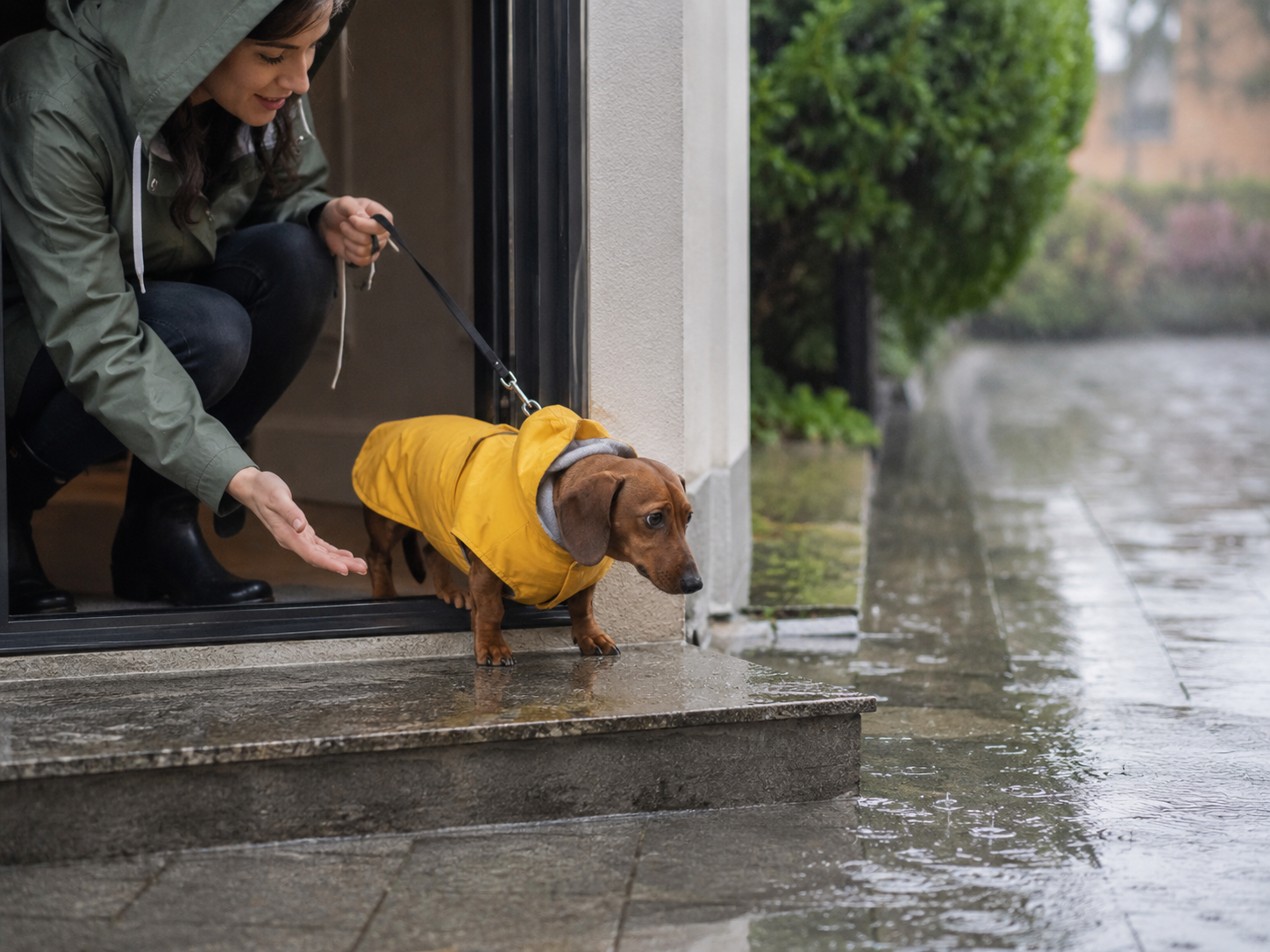
4. Pay Attention to Ears — Especially in Dogs Prone to Ear Problems
Excessive moisture in the ear canal can contribute to conditions that favor otitis externa in susceptible dogs.
Ordinary rain on the outside of the ear does not mean every dog needs an ear cleaner after every walk.
Instead, keep the visible ear area dry and observe for changes.
Contact your veterinarian for:
- head shaking
- repeated ear scratching
- redness
- strong odor
- discharge
- swelling
- pain when the ear is touched
Do not over-clean normal ears
Dogs with recurrent ear disease may need a veterinarian-directed cleaning plan. Do not insert cotton swabs deep into the ear canal or use random home remedies for an inflamed ear.
5. If Your Dog Refuses the Rain, Make the Bathroom Job Easier
Some dogs dislike wet paws, water touching the face, wind, noise or simply the change in routine.
Dragging a frightened or resistant dog into heavy rain can make the experience worse.
Instead:
- choose the most sheltered exit
- use a familiar bathroom area
- keep the outing brief
- reward appropriate toileting
- return indoors promptly
- dry the dog comfortably
For mild rain sensitivity, reward-based gradual exposure can help.
If refusal is new and the dog also appears painful, weak or reluctant to walk in other conditions, consider a veterinary cause rather than assuming the problem is only rain.
Back to guide6. Prepare the Room Before Adding Indoor Exercise
Indoor activity becomes unsafe when enthusiasm exceeds the available space.
Before active games:
- move breakable objects
- block dangerous stairs if necessary
- remove loose electrical cords
- provide traction on slick flooring
- use low, stable obstacles only
- give the dog enough room to turn safely
- avoid high jumping in confined spaces
Puppies, senior dogs and dogs with orthopedic or neurologic conditions need particularly conservative indoor movement.
Back to guide7. Build a Simple Indoor Scent Search
Nose work is one of the easiest ways to create meaningful indoor activity without needing a large room.
Keep food away from dangerous locations, medications, household chemicals and anything the dog should not learn to search through.
Back to guide8. “Find It” Can Turn Part of a Meal Into Enrichment
On an appropriate clean surface, scatter part of the dog's measured food and allow the dog to find it.
Start in a small area.
As the dog understands the game, use slightly wider or more varied search areas.
For multi-dog homes, separate dogs when food competition or resource guarding could occur.
Food-search activities should use part of the dog's normal daily food allowance or otherwise be accounted for in total calories.
Back to guide9. Food Puzzles Add Problem-Solving Without Requiring Fast Movement
Food-dispensing toys and puzzles can turn eating into an activity.
Choose a difficulty level the dog can actually solve.
A puzzle that creates repeated frustration is not automatically better enrichment because it is harder.
Start by:
- showing the dog where food comes from
- making the first attempt easy
- supervising unfamiliar equipment
- checking that pieces cannot be swallowed or chewed off
- increasing difficulty only after success
Wash food toys according to their instructions to prevent food residue from accumulating.
Back to guide10. Make a Simple Towel or Blanket Search
Place a few pieces of food on a clean towel or blanket and fold the fabric loosely so the dog has to use its nose to locate them.
The first version should be easy.
Do not create tight knots that encourage the dog to shred or swallow fabric.
Supervise dogs that chew cloth.
If the dog begins destroying the material rather than searching, switch to a safer enrichment format.
Back to guide11. Cardboard-Box Searches Can Be Cheap and Effective
Place safe objects or crumpled paper inside an open cardboard box and add a few pieces of food for the dog to find.
Remove staples, tape, plastic, sharp edges and anything unsafe before use.
Supervise dogs that eat cardboard or paper.
The activity can be made harder by adding several boxes after the dog understands the basic game.
Back to guide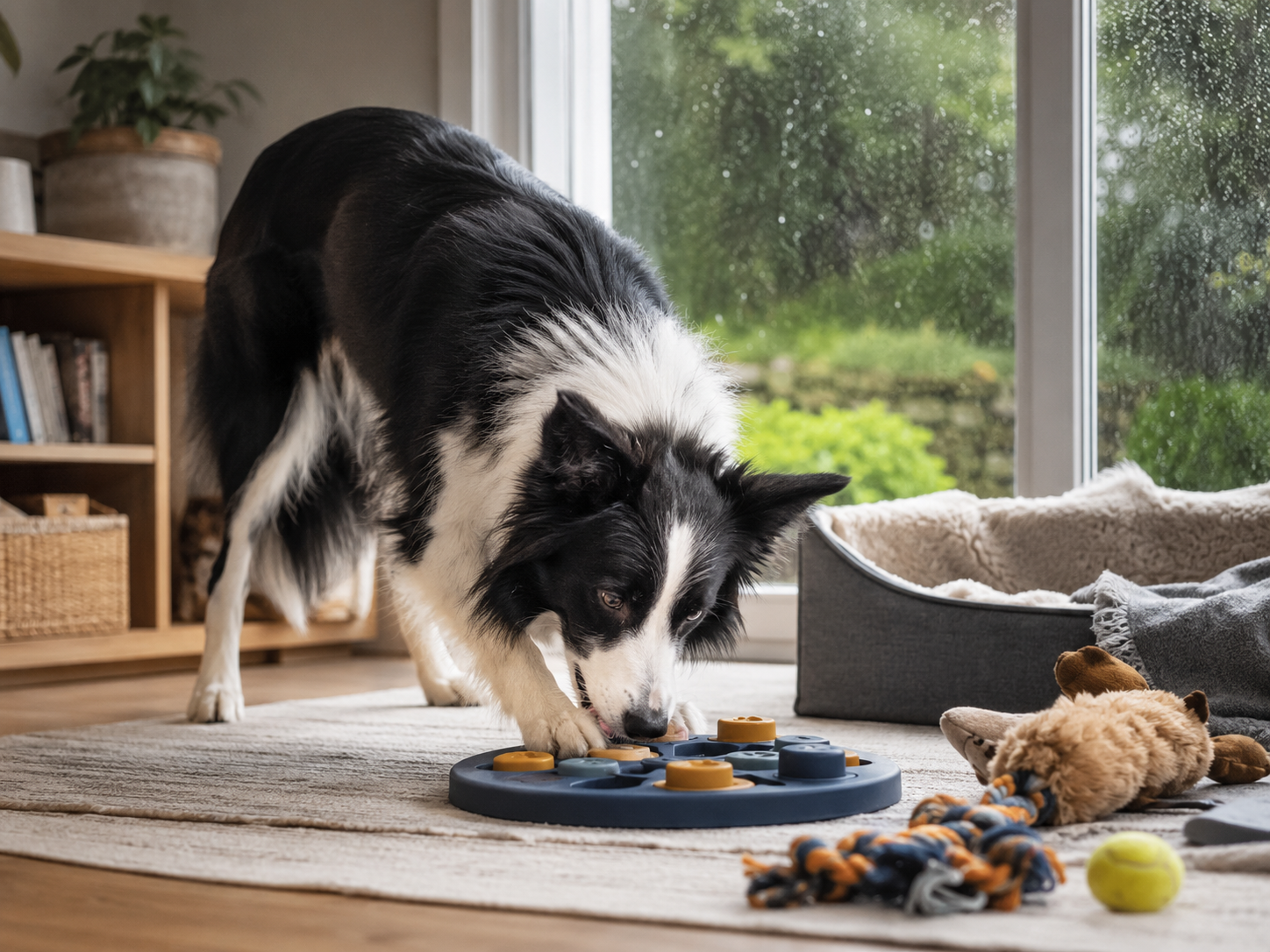
12. Rainy Days Are Useful for Short Reward-Based Training Sessions
Training provides mental work and practical skills at the same time.
Useful indoor skills include:
- touch or hand target
- sit and down
- come when called
- leave it
- drop it
- go to mat
- wait at a doorway
- calm leash handling
- paw handling
- towel-drying practice
Keep sessions short enough that the dog remains interested.
Reward desired behavior with food, play or another reward the dog values.
There is no reason to use leash jerks, shouting, intimidation or other aversive techniques simply because the dog has extra energy indoors.
Back to guide13. Hide-and-Seek Combines Social Interaction With Recall Practice
Ask another person to keep the dog nearby while you hide somewhere easy.
Call once.
Reward the dog when it finds you.
Begin with extremely obvious hiding places and gradually make the search more interesting.
Avoid locations where the dog must jump, climb dangerously or run across slick floors.
Back to guide14. Teach the Dog to Search for a Favorite Toy
Begin by placing a familiar toy where the dog can see it.
Reward investigation or retrieval.
Then partly hide the toy behind furniture or inside an open box.
This activity works best when the dog actually values the selected toy.
For dogs that become overexcited by retrieval games, use fewer repetitions and build calm pauses between searches.
Back to guide15. Tug Can Be an Indoor Activity When Space and Dog Are Appropriate
Tug does not need to become chaotic.
Use an appropriate toy and enough floor traction.
Teach a release cue using reward-based practice.
Keep the toy movement appropriate for the dog's size and physical health.
Avoid aggressive twisting, lifting the dog off the floor, or playing in a way that creates unsafe strain.
Dogs with neck, back, dental or orthopedic problems may need another form of activity.
Back to guide16. Turn Hallways and Rooms Into Short Recall Practice
Two people can stand in separate safe locations and take turns calling the dog.
Reward each successful response.
Keep the distance short enough that the dog can succeed.
Use traction where necessary and avoid creating high-speed sprinting on tile or polished flooring.
For puppies and older dogs, calm walking recalls may be more appropriate than fast running.
Back to guide17. Build a Low, Stable Indoor Obstacle Course
A simple course can encourage controlled movement and problem-solving.
Examples include:
- walking around a chair
- stepping over a very low stable pole
- walking between two objects
- standing on a nonslip mat
- following a gentle curved path
Keep it low and stable
Indoor obstacle work should be adjusted for age, size, fitness and mobility. Avoid unstable furniture, high jumps and slippery flooring.
Dogs with orthopedic, neurologic or significant mobility conditions should follow their veterinarian or rehabilitation professional's activity advice.
Back to guide18. Calm Behavior Is Also a Rainy-Day Skill
A weather-limited day should not become eight hours of continuous games.
Teach the dog that resting on a bed or mat can also be rewarding.
A simple settle exercise:
- place a comfortable mat in a quiet location
- reward voluntary interest in the mat
- reward standing or lying on it
- gradually reward longer calm periods
- release the dog before frustration builds
Predictable activity followed by predictable rest can help prevent the owner from accidentally teaching the dog that constant attention is available all day.
Back to guide19. Appropriate Chewing Can Provide Quiet Engagement
Many dogs enjoy safe chewing or food-stuffed toys during rest periods.
Choose an item appropriate for the individual dog's chewing style and supervise unfamiliar products.
Remove items that break into dangerous pieces or become small enough to swallow.
Dogs with dental disease, broken teeth, swallowing problems or dietary restrictions may need veterinary advice before chew products are used.
Chewing should supplement the day rather than replace movement, interaction and normal rest.
Back to guide20. Puppies Still Need Bathroom Opportunities When It Rains
A puppy does not suddenly have an adult bladder because the weather is bad.
Continue the normal house-training plan with appropriately frequent outdoor opportunities.
Use a sheltered bathroom location where practical, keep the trip focused, reward successful elimination and return indoors.
Good puppy indoor activities include:
- very easy food searches
- name-response games
- gentle recall
- handling practice
- short toy play
- safe chewing
- settling and nap time
Puppy exercise should not be replaced with repetitive high-impact jumping or uncontrolled indoor sprinting.
Back to guide21. Senior Dogs Need Traction and Low-Impact Options
Older dogs may have reduced mobility, arthritis, weaker muscles, sensory changes or difficulty recovering from slips.
Cover slick areas with secure rugs or nonslip mats where practical.
Senior-friendly rainy-day activities can include:
- slow scent searches
- easy food puzzles
- gentle walking through the home
- short reward-based training
- comfortable social interaction
- low-impact movement matched to mobility
Do not assume stiffness or reluctance to move is simply old age.
New or worsening mobility problems deserve veterinary assessment.
Back to guide22. High-Energy Dogs Need Structure, Not Indoor Exhaustion
A highly active dog may appear to need constant movement when a long walk is missed.
But repeatedly trying to physically exhaust the dog inside can create overstimulation and unnecessary injury risk.
Combine several types of activity instead:
Breed type, age and the individual dog's normal exercise requirements still matter.
Back to guide23. Not Every Destructive Behavior Is “Just Boredom”
Chewing, stealing, digging and other exploratory behaviors can increase when appropriate outlets are reduced.
Enrichment, exercise, training, management and suitable chew activities can help meet those needs.
But behavior should not automatically be blamed on boredom.
Destruction can also occur with separation anxiety, noise fear, stress, compulsive behavior or other problems.
Look at when the behavior occurs
A dog that destroys items only when left alone may need a different assessment from a dog that steals shoes while the family is home and under-stimulated.
Persistent or severe behavior problems deserve proper assessment rather than simply adding more toys.
Back to guide24. Food Enrichment Still Counts as Food
Rainy-day games can quietly add many extra calories when every activity uses additional treats.
When practical, use part of the dog's measured meal for searches, puzzles and training.
Treat quantity should fit the individual dog's normal nutrition plan.
Dogs with obesity, food allergies, gastrointestinal disease, kidney disease or another dietary condition may need veterinarian-approved enrichment foods.
Enrichment does not require rich treats. For many dogs, ordinary measured kibble can be used for part of the activity.
Back to guide25. Build a Flexible Rainy-Day Routine
Do not treat this as a strict timetable.
Adapt it to your dog's normal routine and the weather.
The objective is not to reproduce the exact physical mileage of a sunny day.
It is to provide a balanced day that still meets toileting, movement, mental, social and resting needs safely.
Back to guide26. Common Rainy-Day Dog Care Mistakes
Avoid these common problems:
- forcing a normal long walk in unsafe weather
- canceling necessary bathroom opportunities for too long
- letting the dog sprint repeatedly on slick indoor floors
- using unstable furniture as agility equipment
- trying to exhaust a high-energy dog with nonstop activity
- adding large amounts of extra food through enrichment
- leaving wet collars or harnesses on unnecessarily
- ignoring paws after muddy or wet outings
- over-cleaning ears simply because it rained
- punishing a dog that is frightened by heavy rain or storms
- assuming destructive behavior always means boredom
- using unsafe household objects in DIY food puzzles
- forgetting that dogs need rest between activities
27. When Rainy-Day Problems Need Veterinary Attention
Contact your veterinarian for signs such as:
- persistent limping after a slip or outdoor walk
- significant paw pain, wounds or swelling
- new or worsening mobility problems
- skin redness, sores, odor or significant itching
- ear pain, discharge, odor or persistent head shaking
- marked shivering that does not resolve after warming and drying
- unusual weakness or lethargy
- breathing difficulty
- a sudden refusal to walk that also occurs in normal weather
- another significant or worsening health change
A weather change can reveal a problem without necessarily causing it.
For example, a dog that becomes reluctant to move on wet days may be responding to slippery footing, but persistent or worsening stiffness can also reflect an underlying mobility problem.
Severe storm fear, panic or destructive behavior may require veterinary behavior or qualified reward-based behavior support.
Back to guideExplore More Daily Dog Care Guides
28. Frequently Asked Questions
What are good rainy day dog activities?
Useful options include scent searches, food puzzles, hide-and-seek, reward-based training, toy searches, controlled tug, low indoor obstacle work, recalls and appropriate chew activities. Match each activity to the dog's age, health and mobility.
Does indoor enrichment replace a walk completely?
It can replace part of the activity when outdoor conditions are unsafe, but dogs may still need bathroom opportunities and appropriate physical movement. The balance depends on the dog and the weather.
Should I walk my dog in light rain?
Many dogs can walk comfortably in ordinary light rain when footing, visibility and temperature are safe. Shorten or skip the normal walk when conditions become hazardous or the dog is distressed.
What if my dog refuses to go out in the rain?
Use a sheltered route or bathroom location, keep the trip brief, reward successful toileting and avoid dragging the dog into frightening weather. New refusal accompanied by pain or mobility changes deserves veterinary attention.
Should I dry my dog after a rainy walk?
Dry areas where significant moisture remains, especially paws, skin folds, long coat areas and places beneath wet equipment. The amount of drying needed depends on coat type and how wet the dog became.
Should I clean my dog's ears every time it rains?
No. Normal ears do not automatically need cleaning after every wet walk. Keep them dry and observe for redness, odor, discharge, scratching, head shaking or pain. Dogs with recurrent ear disease should follow their veterinarian's care plan.
How do I exercise my dog indoors without slippery-floor injuries?
Use nonslip rugs or mats, keep movement controlled, remove obstacles and avoid repetitive high-speed turns or jumping. Senior dogs and dogs with mobility problems need lower-impact options.
How long should an indoor training session be?
There is no required universal duration. Keep sessions short enough that the dog remains engaged and successful. Several brief sessions can be easier than one long session.
Can scent games tire a dog?
Scent work provides mental engagement and natural exploratory behavior. It can be an excellent part of a rainy-day plan, but it does not need to be described as a direct minute-for-minute substitute for physical exercise.
Can I make DIY food puzzles?
Yes, when materials are safe and the dog is supervised. Remove staples, tape, plastic, sharp pieces and anything the dog is likely to swallow. Stop if the dog begins eating the puzzle material.
What indoor activities are good for senior dogs?
Low-impact scent searches, easy food puzzles, short training sessions, gentle controlled movement and social interaction can work well. Provide traction and adapt activity to the dog's mobility and medical condition.
Why is my dog destructive on rainy days?
Reduced exercise or enrichment can contribute, but destruction can also occur with anxiety, noise fear, separation problems or other behavior conditions. Look at the entire pattern rather than assuming boredom is the only cause.
Should I give extra treats for every rainy-day game?
Not necessarily. Use part of the dog's measured meal for food-based enrichment when appropriate and account for treats within the overall nutrition plan.
29. Veterinary & Behavior Sources
This guide was prepared with reference to veterinary guidance on indoor enrichment, environmental safety, senior mobility, wet-area care and humane reward-based training. Sources checked August 13, 2026.
- American Animal Hospital Association — Boredom Busters: Indoor Enrichment for Dogs
- American Animal Hospital Association — Enrichment and Mental & Emotional Wellbeing
- Merck Veterinary Manual — Preventive Health Care, Exercise and Environmental Enrichment
- Merck Veterinary Manual — Exercise, Mental Stimulation and Destructive Behavior
- American Animal Hospital Association — Senior Pet Mobility and Low-Impact Exercise
- AAHA Senior Care Guidelines — Mobility, Traction and Home Modifications
- Merck Veterinary Manual — Ear Infections and Otitis Externa in Dogs
- American Animal Hospital Association — Water Exposure, Drying and Ear Checks
- American Veterinary Society of Animal Behavior — Humane Dog Training Position Statement
Veterinary & Activity Disclaimer
Daily Dog Care Guide provides general educational information for dog owners. This article does not replace veterinary examination, diagnosis, treatment, rehabilitation advice or an individualized exercise plan.
Exercise and enrichment should be adjusted for age, breed type, body condition, fitness, mobility, orthopedic health and other medical conditions.
Contact a veterinarian if your dog develops significant limping, pain, weakness, breathing difficulty, paw injury, skin disease, ear pain, persistent head shaking, new mobility problems or another concerning health change.
Severe storm fear, panic, aggression or persistent destructive behavior may require qualified veterinary or reward-based behavior support.
Final Thoughts
A rainy day does not need to be a failed dog-care day.
It simply changes how the dog's needs are met.
Use the outdoors when the weather is safe. Shorten the route when conditions require it. Keep bathroom opportunities predictable. Dry the dog after wet outings and check paws and areas where moisture remains trapped.
Indoors, think beyond simply throwing a ball down the hallway.
Let the dog sniff. Search. Solve. Train. Chew appropriately. Move on safe surfaces. Interact with the family. Then rest.
Puppies may need more frequent toileting and simpler games. Senior dogs may need nonslip flooring and low-impact movement. High-energy dogs benefit from a mixture of physical activity, scent work, problem-solving and calm periods—not an attempt to exhaust them at any cost.
The best rainy-day plan is not the one with the longest list of games.
It is the one that gives your individual dog enough safe movement, meaningful mental activity, normal care and enough time to settle again.
Back to guideSupervised Enrichment Ideas
Choose enrichment that suits your dog’s size and chewing style, supervise use, and remove damaged items.
A supervised enrichment tool that can add mental work to food or treat time.
View on Amazon →Optional product • paid linkDog Lick Mat with Suction CupsA food-enrichment option for supervised licking activities and calm indoor engagement.
View on Amazon →Optional product • paid linkDog Snuffle Mat for Slow FeedingA supervised sniffing and food-search activity for mental enrichment.
View on Amazon →Affiliate disclosure: As an Amazon Associate I earn from qualifying purchases. Always check size, fit, materials, labels, and your dog’s individual needs before buying.
A Creative Break for Dog-Loving Kids
Explore puppy coloring and activity books for screen-free creative time, quiet afternoons, travel, and young dog fans.
See all dog-care products & books →Helpful next steps
Continue with a related guide, tool, or product resource.