How to Stop a Dog Pulling on the Leash: Loose-Leash Training Guide
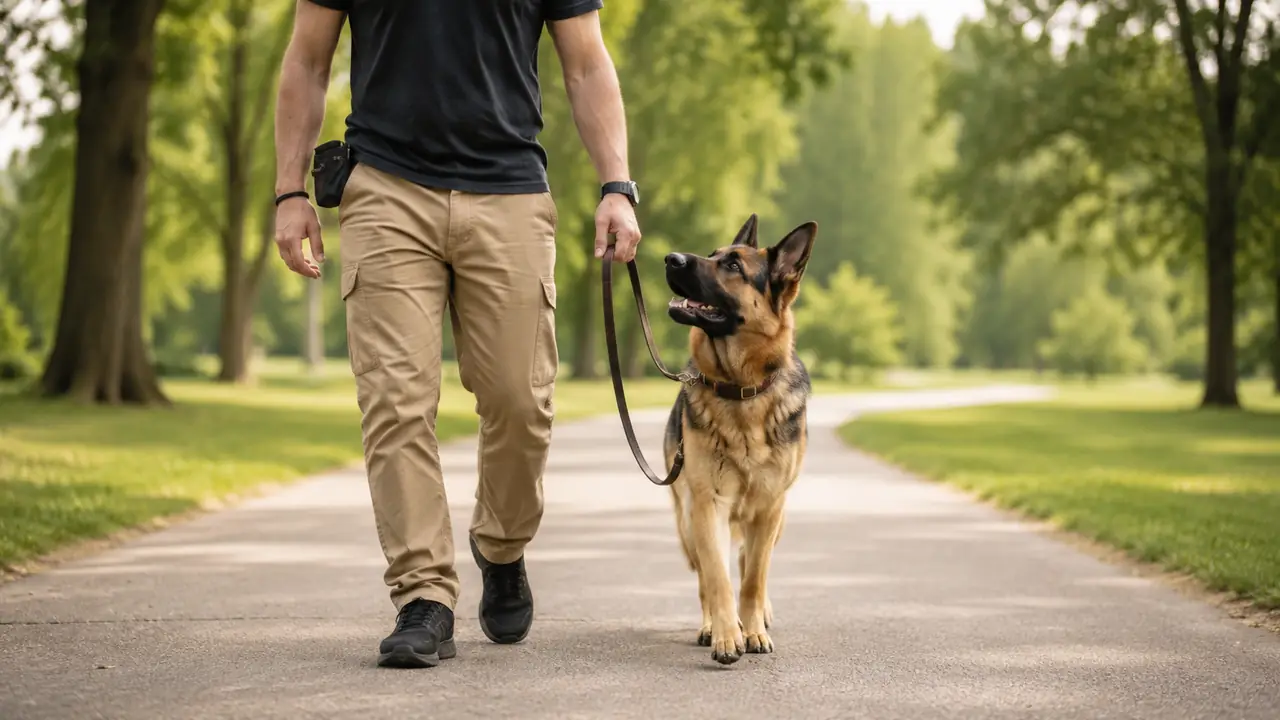
Loose-leash walking is a learned skill, not something dogs automatically understand. The goal is not to force a perfect heel for an entire walk. It is to teach your dog that staying within a comfortable leash range, checking in with you, and moving without constant tension can still lead to the things dogs enjoy—walking, exploring, sniffing, and moving forward.
Updated August 13, 2026 · Veterinary behavior sources checked
Pulling caused by fear, panic, aggression, or reactivity needs a different safety plan from ordinary goal-directed leash pulling.
Many dogs learn to pull for a very simple reason: pulling gets them closer to something they want.
The dog reaches the end of the leash and continues toward a tree. The person keeps walking. The dog reaches the tree and sniffs.
From the dog's perspective, the strategy worked.
Repeat that hundreds of times and the tight leash becomes part of the walking pattern.
This does not mean the dog is trying to dominate the owner or deliberately make the walk difficult.
Dogs also naturally move at different speeds from people and have powerful reasons to explore their surroundings. Smells, movement, animals, people, sounds, and familiar destinations can all compete for attention.
Loose-leash training changes the pattern by making comfortable leash movement more rewarding and by preventing repeated pulling from being the easiest route to everything the dog wants.
Quick Answer: How Do You Stop a Dog Pulling on the Leash?
Begin in a quiet place and reward your dog frequently whenever the leash is loose and the dog stays within a comfortable range.
If the dog pulls toward an ordinary non-frightening goal, stop forward progress or calmly move away rather than allowing the tight leash to deliver the reward. Resume and reward when slack returns.
Use access to safe sniffing and exploration as part of the reward system, not only food.
Increase distraction gradually. If the dog cannot disengage from something, create more distance instead of repeatedly correcting the leash.
If pulling is connected to fear, barking, lunging, escape attempts, aggression, or panic, do not treat it as ordinary loose-leash training. Prioritize distance, safety, and qualified behavior support.
Why Dogs Pull on the Leash
In This Loose-Leash Training Guide
1. Why Pulling Becomes a Strong Habit
Dogs repeat behaviors that successfully produce outcomes they value.
If the dog pulls and still reaches the grass, another dog, a doorway, a smell, or the park entrance, the tight-leash behavior has worked.
The owner may not have intended to reward pulling, but access to the environment can be a powerful reward.
That creates an important training principle:
Do not make pulling the most reliable way to move toward ordinary things your dog wants.
At the same time, do not turn every walk into a constant battle over leash length. Give the dog appropriate opportunities to sniff and explore so the environment is part of the training plan rather than something the dog must fight to reach.
Back to guide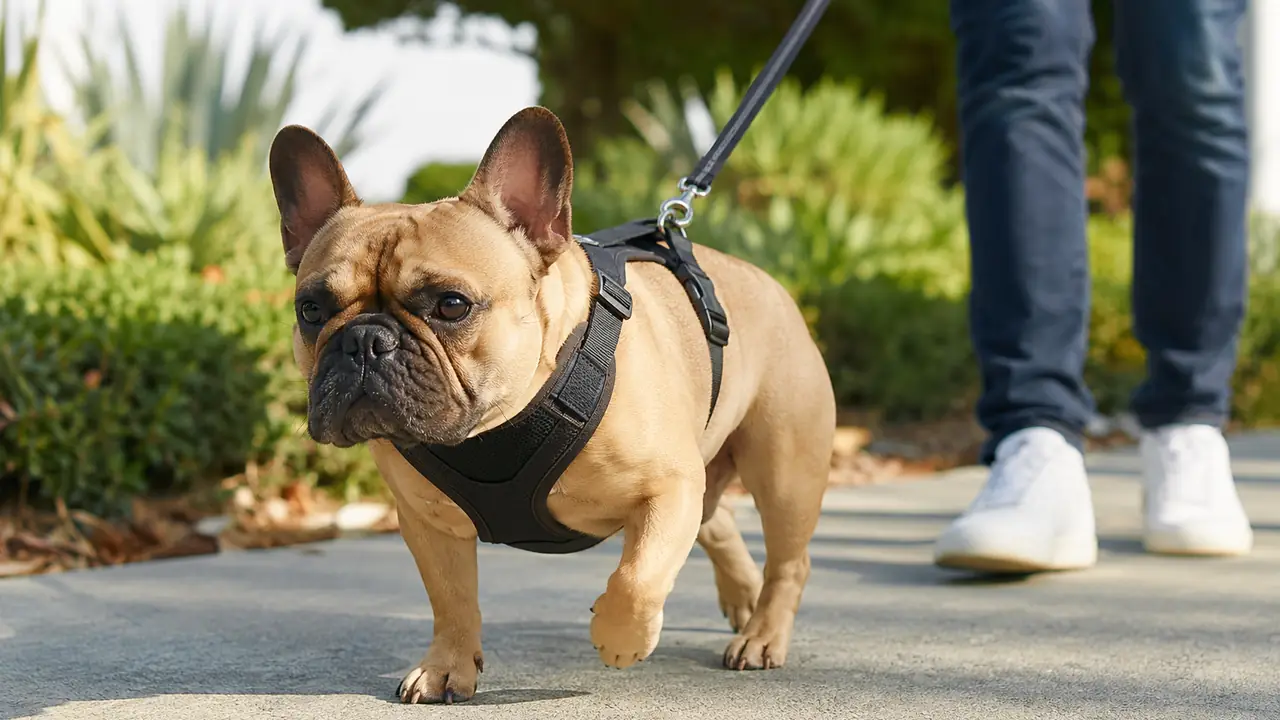
2. Loose-Leash Walking Is Not the Same as a Formal Heel
For an everyday family walk, the dog usually does not need to stay beside your knee and stare at you continuously.
A practical loose-leash walk can allow the dog to move slightly ahead, beside, or behind you as long as the leash remains comfortably slack and the movement is safe.
A useful everyday goal is:
- no constant pressure on the leash
- the dog can change speed with you
- the dog can respond to a turn or change of direction
- the dog can periodically check in with you
- the dog can sniff when released to do so
- both dog and handler remain physically comfortable
A formal heel is a separate, more precise skill that may be useful for short periods in crowded or difficult areas.
Back to guide3. Choose Comfortable, Secure Walking Equipment
Equipment should help keep the dog safe while training takes place. It should not be expected to teach loose-leash walking on its own.
Fit matters. The dog should not be able to back out of the harness or collar, and straps should not repeatedly rub the skin or restrict natural movement.
Dogs with unusual anatomy, orthopedic problems, airway disease, neck pain, or mobility problems may need equipment selected with veterinary guidance.
A training tool should not depend on pain or fear
Avoid electronic shock collars, prong collars, choke chains, harsh leash corrections, and other aversive equipment intended to suppress pulling through discomfort or intimidation.
4. Make Sure Pulling Is Not Being Complicated by Pain or Physical Discomfort
Training assumes that the dog can move comfortably.
A sudden change in walking behavior can sometimes reflect pain, injury, breathing difficulty, weakness, or another medical issue.
Contact a veterinarian when walking changes occur with:
- limping or uneven movement
- reluctance to walk or climb
- neck, back, or limb pain
- coughing or gagging with leash pressure
- unusual breathing difficulty
- rapid fatigue or exercise intolerance
- weakness or collapse
- a sudden major behavior change outdoors
Do not increase training pressure to compensate for a dog that is physically uncomfortable.
Back to guide5. Start Where Your Dog Can Actually Learn
A busy street full of dogs, bicycles, vehicles, children, food smells, and unfamiliar people is a difficult classroom.
Begin somewhere easier.
Possible starting places include:
- inside the home
- a quiet garden or yard
- a calm driveway
- a low-traffic sidewalk
- a quiet outdoor area at an uncrowded time
Training difficulty has several parts: distance, duration, distraction, and arousal.
Change one or two of those gradually rather than making everything harder at the same time.
If your dog was successful indoors but pulls continuously on a crowded street, the skill has not necessarily disappeared. The environment may simply be too difficult.
Back to guide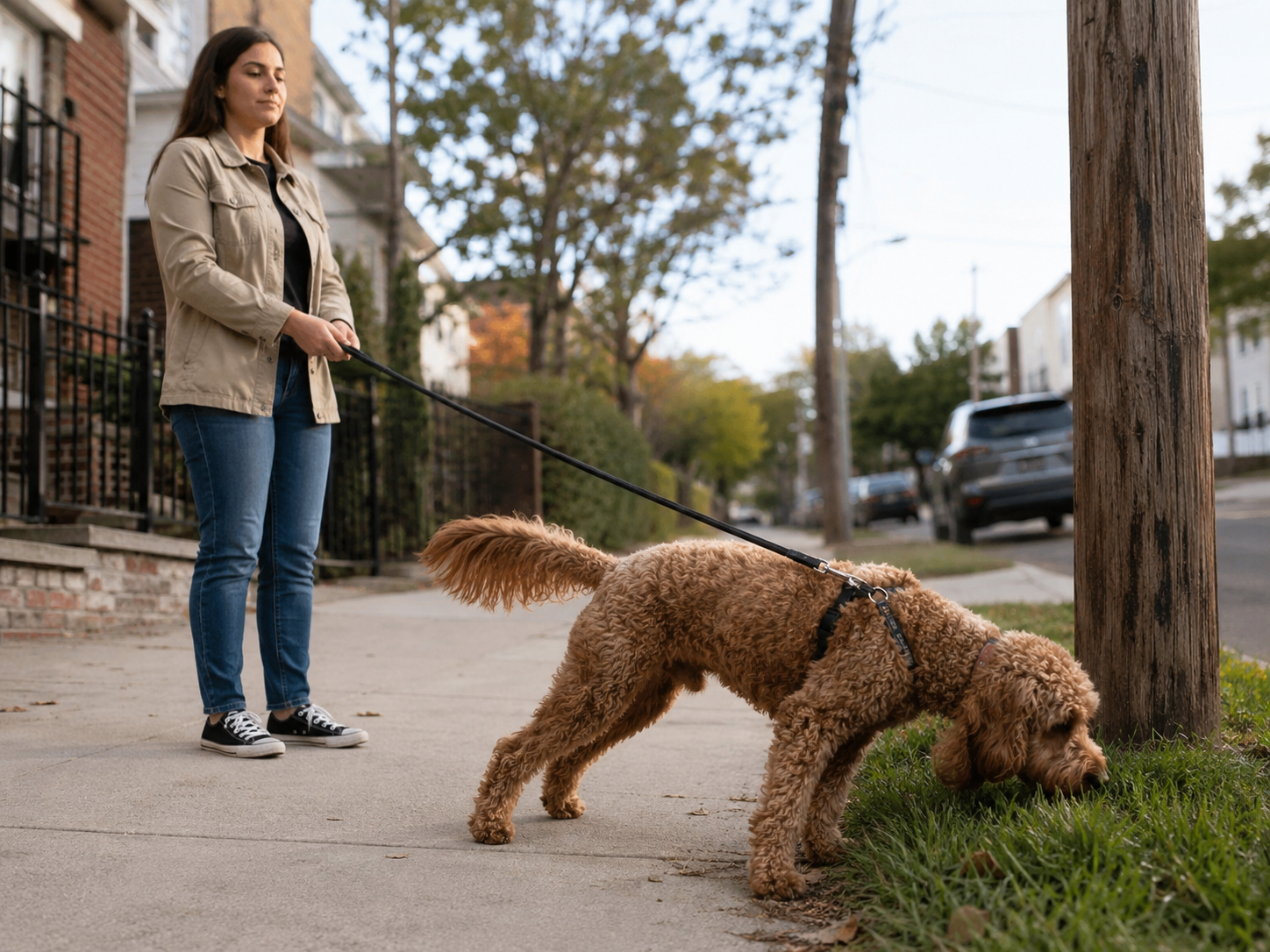
6. Reward the Loose Leash Before You Need to Correct the Tight One
Many owners notice the dog only after pulling starts.
Loose-leash training becomes clearer when the dog is frequently reinforced for the behavior you actually want.
Reward moments such as:
- standing beside you with slack in the leash
- taking several steps without creating tension
- looking back or checking in voluntarily
- slowing when you slow
- turning with you
- passing a mild distraction without pulling
Rewards can include small food pieces, praise, moving forward, permission to sniff, access to a safe location, or another outcome the individual dog values.
Deliver the reward promptly enough that the dog can connect it with the loose-leash behavior.
Back to guide7. Teach the First Few Loose-Leash Steps
Do not begin by expecting a twenty-minute perfect walk.
Early in training, frequent reinforcement is useful. Rewards can become more varied later as the skill becomes stronger.
Back to guide8. What Should You Do When the Leash Becomes Tight?
For ordinary goal-directed pulling in a calm environment, avoid continuing straight toward the thing the dog is pulling to reach.
You can stop forward progress and wait for the dog to create slack, or move calmly away from the attraction.
The moment the leash becomes loose again, mark or reward that change and resume movement.
The lesson becomes:
Tight leash does not efficiently move us toward the goal. A loose leash makes useful movement possible again.
This rule does not fit every emotional situation
If your dog is pulling because it is frightened and trying to escape a trigger, do not stand still and force the dog to remain near the thing it fears. Increase distance and focus on safety.
9. Teach a Calm “Let's Go” Turn Before You Need It
A smooth change of direction is one of the most useful walking skills.
Practice in a quiet area first.
A simple sequence is:
- say your walking-turn cue
- change direction smoothly
- encourage the dog to move with you
- reward when the dog catches up with a loose leash
- repeat from both directions
The goal is not to surprise the dog with abrupt leash pressure.
You are teaching that your verbal cue predicts a coordinated change of direction.
Once learned, this skill can help you leave a distracting situation before pulling becomes intense.
Back to guide10. Use Sniffing as Part of the Reward System
Sniffing is one of the main ways dogs explore their environment.
Instead of trying to prevent every sniff, use access to appropriate sniffing as a reward for loose-leash walking.
For example:
- walk several steps with the leash loose
- mark or praise the success
- give a release cue such as “go sniff”
- allow relaxed exploration in a safe area
- use your walking cue when it is time to continue
This teaches the dog that staying connected to you does not mean losing access to the environment.
If the dog drags you toward every scent and then receives unrestricted sniffing, pulling can remain the route to the reward. The sequence matters.
Back to guide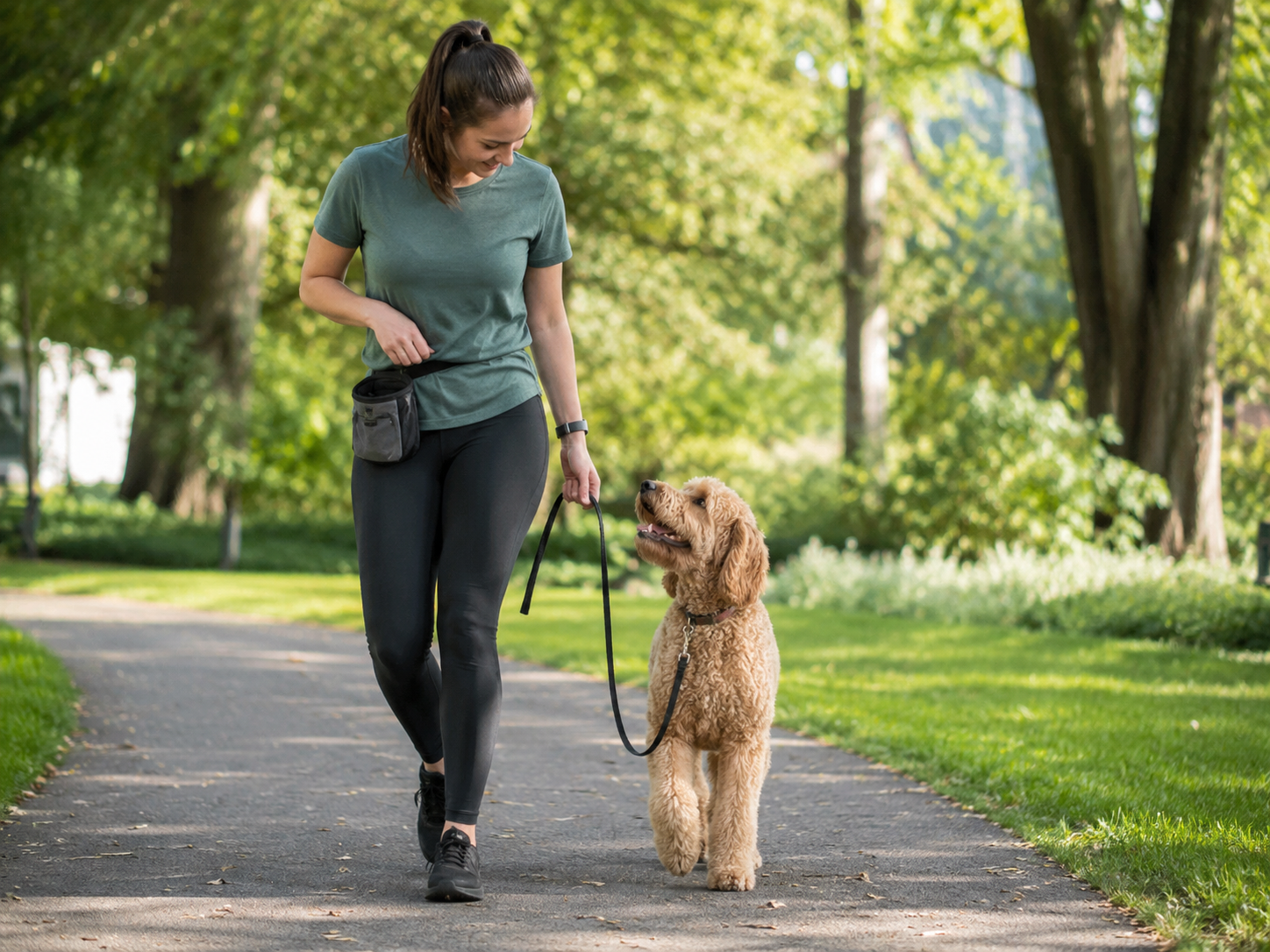
11. Loose-Leash Training Can Begin Before You Leave the House
Some dogs are already highly aroused before the front door opens.
The leash appears, the dog races around, the door opens, and the dog launches forward.
Practice the first part separately.
Work on:
- calm leash attachment
- standing near the door without immediately opening it
- opening the door a small amount while the leash stays manageable
- walking through without rushing
- taking a few rewarded loose-leash steps immediately outside
Do not require prolonged stillness from a dog that is only beginning to learn.
Reward small moments of workable calm and build from there.
Back to guide12. Add Distractions One Level at a Time
A dog that walks beautifully in the garden may still pull on a busy street.
That is normal during skill development.
Move through increasingly difficult environments only when the dog has a reasonable chance of succeeding.
If leash tension suddenly becomes constant at the next level, reduce the challenge instead of assuming the dog has decided to ignore its training.
Back to guide13. Pulling Toward Dogs or People Can Have More Than One Cause
A dog pulling toward another dog may genuinely want to greet.
But excitement, frustration, social uncertainty, or fear can produce similar forward movement.
Avoid automatically allowing the dog to reach every person or dog after pulling.
Instead:
- create distance before pulling becomes intense
- reward check-ins or calm observation
- use your practiced change-of-direction cue
- walk past at a wider distance when appropriate
- skip greetings when the dog is too aroused
- do not force interactions with unfamiliar dogs or people
If a greeting is appropriate, approach only while the dog can maintain a manageable leash.
Pulling should not become the ticket that repeatedly earns social access.
Back to guide14. Leash Reactivity Is Not Simply “Bad Loose-Leash Walking”
Barking, lunging, whining, frantic pulling, freezing, retreating, and struggling to disengage around dogs, people, vehicles, or other triggers can indicate a more complex emotional response.
Frustration can occur when the leash prevents access to something the dog wants. Fear can cause the dog to pull away, lunge defensively, or urgently seek distance.
When the dog is reactive, distance is a training tool
Cross the road, turn away, use a visual barrier, or leave the area before the response escalates. Do not force the dog to remain close to the trigger simply to practice walking beside you.
A dog that cannot safely pass other dogs or people may need an individualized behavior plan rather than ordinary loose-leash exercises alone.
Growling, snapping, biting, severe fear, or dangerous lunging warrants qualified professional support.
Back to guide15. Puppy Leash Training Should Begin With Short, Positive Sessions
Puppies are learning several things at once: how equipment feels, how to follow a person, how to explore safely, and how to handle an unfamiliar world.
Early puppy practice can include:
- positive introduction to a comfortable harness or collar
- brief leash practice indoors
- rewarding voluntary attention
- one or two loose-leash steps at a time
- safe sniffing and exploration
- short sessions before the puppy becomes tired or overwhelmed
Young puppies should not be expected to perform a long formal walk simply because they can physically move on a leash.
Follow veterinary guidance about vaccination, disease risk, appropriate exercise, and safe public exposure for your individual puppy.
Back to guide16. Strong Pullers Need a Safety Plan While Training Is Still Developing
If the dog can pull the handler off balance, physical safety comes before achieving a perfect walking style.
Reduce risk by:
- choosing well-fitted secure equipment
- walking in lower-distraction areas during early training
- avoiding icy, slippery, crowded, or narrow locations when possible
- creating distance from known triggers early
- keeping both hands available when extra control is needed
- getting professional help before somebody is injured
Equipment can improve management, but no harness or collar replaces the training itself.
If you cannot physically control the dog safely, do not wait for the problem to become an accident.
Back to guide17. Separate “Walk With Me” Time From “Go Sniff” Time
A dog does not need to spend the entire outing in one walking mode.
You can build a clearer routine by having periods of connected loose-leash walking and periods of freer sniffing within a safe leash range.
This makes expectations more predictable and lets the environment become a useful training reward.
The aim is not to micromanage every step. It is to prevent constant pulling while still allowing normal exploration.
Back to guide18. A Walk Is Important, but Loose-Leash Training Is Not an Exercise Program
Dogs also need appropriate physical activity, mental enrichment, rest, social opportunities, and chances to perform normal behaviors.
A dog that has few outlets may be especially eager to reach every smell and every point of interest when finally taken outside.
However, simply exhausting the dog does not teach leash skills.
Build a balanced routine and teach the walking behavior separately.
Depending on the dog, a balanced day may include:
- age- and health-appropriate exercise
- sniffing and exploration
- mental enrichment
- brief reward-based training
- play
- social interaction
- adequate rest
Exercise needs vary widely, so avoid using one universal walking-time formula for every breed, age, and health condition.
Back to guide19. Common Loose-Leash Training Mistakes
Avoid these common problems:
- using leash jerks to correct pulling
- using prong, choke, or electronic collars as punishment
- letting the dog pull to every smell or greeting
- rewarding only after the dog has already pulled
- starting every lesson in a highly distracting environment
- asking for too many steps too soon
- preventing all sniffing and exploration
- forcing a fearful dog closer to its trigger
- confusing loose-leash walking with a permanent formal heel
- expecting equipment to train the dog by itself
- using the same response for excitement, fear, and reactivity
- ignoring pain or a sudden change in walking behavior
The most useful plan teaches the dog what succeeds instead of relying on repeated physical correction for what fails.
Back to guide20. A Practical Loose-Leash Training Ladder
This is a progression, not a seven-day deadline. Stay at each level until your dog is succeeding consistently enough to make the next step reasonable.
If performance drops sharply, return temporarily to an easier level rather than increasing corrections.
Back to guide21. Measure More Than Just “Did My Dog Pull?”
Good training progress can appear in several ways before the entire walk is consistently loose.
Training progress is not always perfectly linear. A new route, unusually exciting smell, poor rest, crowded environment, or stressful event can temporarily make walking harder.
Back to guide22. When to Ask a Veterinarian or Behavior Professional for Help
Ordinary leash pulling is often appropriate for a qualified reward-based trainer to help with.
Get training or behavior support when:
- the dog is physically difficult for you to control
- pulling repeatedly causes falls or injuries
- the dog lunges at people, dogs, bicycles, or vehicles
- the dog redirects biting or grabbing toward the handler or leash
- the dog shows significant fear outdoors
- the dog cannot remain at a workable distance from common triggers
- consistent reward-based practice is not producing safe progress
Veterinary assessment is important when:
- walking behavior changes suddenly
- there is lameness, pain, weakness, or exercise intolerance
- the dog coughs, gags, or has breathing difficulty
- fear or aggression appears suddenly
- an older dog develops major new behavior changes
- the dog has another medical sign accompanying the walking problem
Significant aggression, profound fear, self-injury, or complex behavior problems may warrant veterinary behavior referral.
Choose training professionals who use reward-based, evidence-informed methods rather than pain, intimidation, or leash corrections.
Back to guideExplore More Daily Dog Care Guides
23. Frequently Asked Questions
How do I stop my dog pulling on the leash?
Start in a low-distraction place and reward the dog frequently for a slack leash. For ordinary goal-directed pulling, avoid continuing toward the reward while the leash is tight. Resume movement or provide access to sniffing when the leash is loose again.
Should I stop every time my dog pulls?
Stopping forward progress can help with ordinary pulling when the dog is trying to reach something desirable. It is not the correct response when a frightened dog is trying to create distance from a trigger. In that situation, move away and prioritize safety.
Is a harness better than a collar for a dog that pulls?
A well-fitted harness can reduce pressure on the neck and throat and can be a useful management choice while training. Fit and the dog's individual anatomy matter. Equipment does not teach loose-leash walking by itself.
Will a front-clip harness stop pulling?
Some harness designs can make physical management easier for some dogs, but no harness automatically teaches the walking skill. The dog still needs reinforcement for a loose leash, gradual practice, and appropriate management of distractions.
Should my dog walk beside me for the entire walk?
Not for ordinary family walks. A practical loose-leash walk can allow safe exploration and sniffing as long as the leash remains manageable. A formal heel is a separate, more precise behavior.
Can I let my dog sniff during leash training?
Yes. Sniffing can be valuable exploration and can also be used as a reward. One useful pattern is loose-leash walking followed by a release cue that gives the dog time to sniff a safe area.
Why does my dog pull more at the start of the walk?
Anticipation and excitement are often highest when the leash appears and the door opens. Practice calm leash attachment, door exits, and several rewarded steps before launching into the full walk.
Why does my dog pull toward other dogs?
Excitement, frustration, social interest, or fear can all contribute. Create enough distance to observe your dog's body language and reward calm behavior. Do not make pulling the routine way to reach other dogs.
Should I use leash corrections when my dog pulls?
Current veterinary behavior guidance favors reward-based methods and advises against aversive techniques such as leash jerks, prong collars, choke chains, and electronic collars. Teach and reinforce the walking behavior you want instead.
Can an older dog learn loose-leash walking?
Yes. Adult and senior dogs can learn new walking patterns. Older dogs may need shorter sessions, comfortable equipment, and adjustments for mobility, pain, vision, hearing, or other health changes.
How long does loose-leash training take?
There is no fixed timetable. It depends on the dog's learning history, environment, arousal, reinforcement, consistency, and how often pulling has previously been successful. Measure gradual improvement rather than expecting a specific number of days.
When does leash pulling need professional help?
Get help when pulling is physically unsafe, the dog lunges or shows aggression, fear is significant, the handler cannot control the dog safely, or consistent reward-based training is not producing progress. Sudden changes accompanied by pain or other physical signs also need veterinary assessment.
24. Veterinary & Behavior Sources
This educational guide was prepared with reference to veterinary behavior and reward-based dog-training guidance. Sources checked August 13, 2026.
- VCA Animal Hospitals — Loose Leash Walking With Dogs
- American Animal Hospital Association — Expert Dog Training Tips
- American Animal Hospital Association — Harness and Collar Walking Guidance
- American Animal Hospital Association — Safely Walking a Reactive Dog
- American Animal Hospital Association — Understanding Reactive Dogs
- Merck Veterinary Manual — Behavior Modification in Dogs
- American Veterinary Society of Animal Behavior — Humane Dog Training Position Statement
Veterinary & Behavior Disclaimer
Daily Dog Care Guide provides general educational information for dog owners. This article does not diagnose a medical or behavioral disorder and does not replace veterinary examination, treatment, emergency care, or an individualized behavior-modification plan.
Walking and equipment needs vary with age, body size, anatomy, mobility, health, behavior, environment, and handler ability. Contact a qualified veterinarian if your dog develops sudden walking changes, pain, lameness, coughing, breathing difficulty, weakness, severe fear, aggression, or other concerning signs.
Final Thoughts
A dog that pulls is not necessarily trying to be difficult.
The dog may simply have learned that forward pressure works, may naturally move faster than you, or may be strongly motivated by the smells, movement, animals, and opportunities outside.
Start somewhere the dog can succeed. Reward slack before tension appears. Teach smooth turns. Let appropriate loose-leash walking earn forward movement and safe sniffing.
Do not confuse a relaxed everyday walk with a permanent formal heel, and do not use pain or fear to force the dog into position.
Most importantly, match the plan to the reason for the pulling.
A dog pulling toward a tree for a smell can learn that slack makes the tree accessible. A frightened dog pulling away from a trigger needs distance. A dog barking and lunging at other dogs may need a behavior plan beyond ordinary leash manners.
A better walk is built from repeated small choices: a softer leash, a calmer turn, a voluntary check-in, a safe sniff, and another successful step together.
Back to guideLoose-Leash Training Gear
Fit matters more than the label on a product. Training equipment should support, not replace, calm reward-based leash practice.
A walking harness option to compare for fit, comfort, and everyday leash practice.
View on Amazon →Optional product • paid linkReflective Dog Leash with AccessoryA practical everyday leash option with added visibility for outdoor walks.
View on Amazon →Optional product • paid linkDog Treat Pouch for TrainingKeeps small rewards easy to reach during short training sessions and walks.
View on Amazon →Affiliate disclosure: As an Amazon Associate I earn from qualifying purchases. Always check size, fit, materials, labels, and your dog’s individual needs before buying.
Helpful next steps
Continue with a related guide, tool, or product resource.