How to Stop Dog Barking: Causes, Triggers and Calm Training

Barking is normal canine communication, so the goal is not to make a dog completely silent. When barking becomes excessive, the useful question is what triggers it, what emotion or consequence keeps it going, and what calmer behavior the dog can learn instead.
Updated August 13, 2026 · Veterinary behavior sources checked
Sudden barking, pain, confusion, severe fear, aggression, or major behavior change can need veterinary assessment.
A bark at the door can be useful. It tells you that somebody has arrived.
But barking can become difficult when it happens at every person, every dog, every sound, every delivery, every window movement, or for long periods when nobody can help the dog settle.
The sound itself does not explain the cause.
Dogs may bark because they are alert, excited, frightened, frustrated, socially motivated, seeking attention, reacting to another animal, or struggling when left alone. In some situations barking becomes stronger because it has repeatedly produced a useful consequence for the dog.
That is why “How do I stop my dog barking?” is usually better reframed as: “Why is my dog barking in this situation, and what can I change?”
Once the cause and trigger are clearer, you can manage the environment, reduce unnecessary pressure, and teach a behavior that works better for both dog and household.
Quick Answer: How Do You Stop Excessive Dog Barking?
Do not begin by trying to suppress every sound.
First identify what happens immediately before the barking and what happens immediately afterward. Reduce preventable exposure to the trigger, especially if the dog is repeatedly practicing the same reaction.
Then teach and reward an alternative response such as looking at you, moving away from a window, going to a mat, following you away from the door, sniffing for food, or calmly passing a trigger at greater distance.
If fear or anxiety is involved, work at an intensity where the dog remains comfortable enough to learn. Do not deliberately overwhelm the dog until it stops reacting.
Sudden barking or barking accompanied by pain, confusion, aggression, sensory changes, severe anxiety, or other health changes deserves veterinary attention.
Common Reasons Dogs Bark
In This Dog Barking Guide
1. Barking Is Normal — Excessive Barking Needs Context
Barking is part of normal canine communication.
A dog that gives several alert barks when somebody approaches the home is not automatically displaying a behavioral disorder.
The problem becomes more significant when barking is frequent, prolonged, difficult to interrupt, associated with severe fear or aggression, creates safety concerns, or substantially affects the dog's or household's quality of life.
Context matters.
Five barks at an unexpected visitor have a very different meaning from forty minutes of pacing and vocalizing after an owner leaves.
The goal of training should therefore be realistic: reduce unnecessary or problematic barking while preserving normal communication.
Back to guide
2. Find Out Why the Dog Is Barking Before Choosing a Training Plan
The same training response does not fit every kind of barking.
If barking gets attention, the plan may involve changing what receives attention and reinforcing a quieter alternative.
If barking comes from fear, simply withholding attention does not address the fear.
If barking begins only when the dog is alone, a separation-related problem may need to be investigated.
If an older dog suddenly begins vocalizing at night, a medical or cognitive problem may need consideration.
Ask four questions:
- What happens immediately before the barking?
- What does the dog's body look like during it?
- What happens immediately after the barking?
- Does the same pattern occur every time?
These questions help separate the observable sound from the motivation and learning history behind it.
Back to guide3. Keep a Barking Trigger Log for Several Days
Barking often feels random until it is written down.
A simple record can reveal predictable times, locations, triggers, and consequences.
Recording short video clips can also be useful when it is safe to do so, especially when the behavior is difficult to interpret in real time.
Back to guide4. Read the Whole Dog, Not Only the Volume
Loud barking does not automatically mean aggression, and quiet behavior does not automatically mean comfort.
Observe posture, facial expression, movement, breathing, distance from the trigger, and how easily the dog can disengage.
Signs that arousal may be becoming too high include:
- increasing body stiffness
- repeated lunging toward the trigger
- rapid pacing
- panting unrelated to heat or exercise
- intense scanning
- inability to move away
- difficulty responding to familiar cues
- rapidly escalating vocalization
A dog's ability to take food or respond to a familiar cue can provide useful context, but it is not a stand-alone test of emotional state.
If the dog is already highly aroused, make the situation easier before attempting more training.
Back to guide5. Management Is Part of Training, Not a Shortcut
Every uncontrolled rehearsal gives the dog another opportunity to practice the barking pattern.
Management reduces those rehearsals while you teach something different.
Reducing access to a trigger is not “giving in.”
It creates an environment in which successful learning becomes more realistic.
Back to guide6. How to Reduce Barking at the Door
Door barking often combines alerting, excitement, anticipation, and sometimes fear of unfamiliar people.
Start when no real visitor is waiting outside.
A dog that is fearful of visitors may require a separate fear or aggression plan rather than ordinary door-manners training.
Back to guide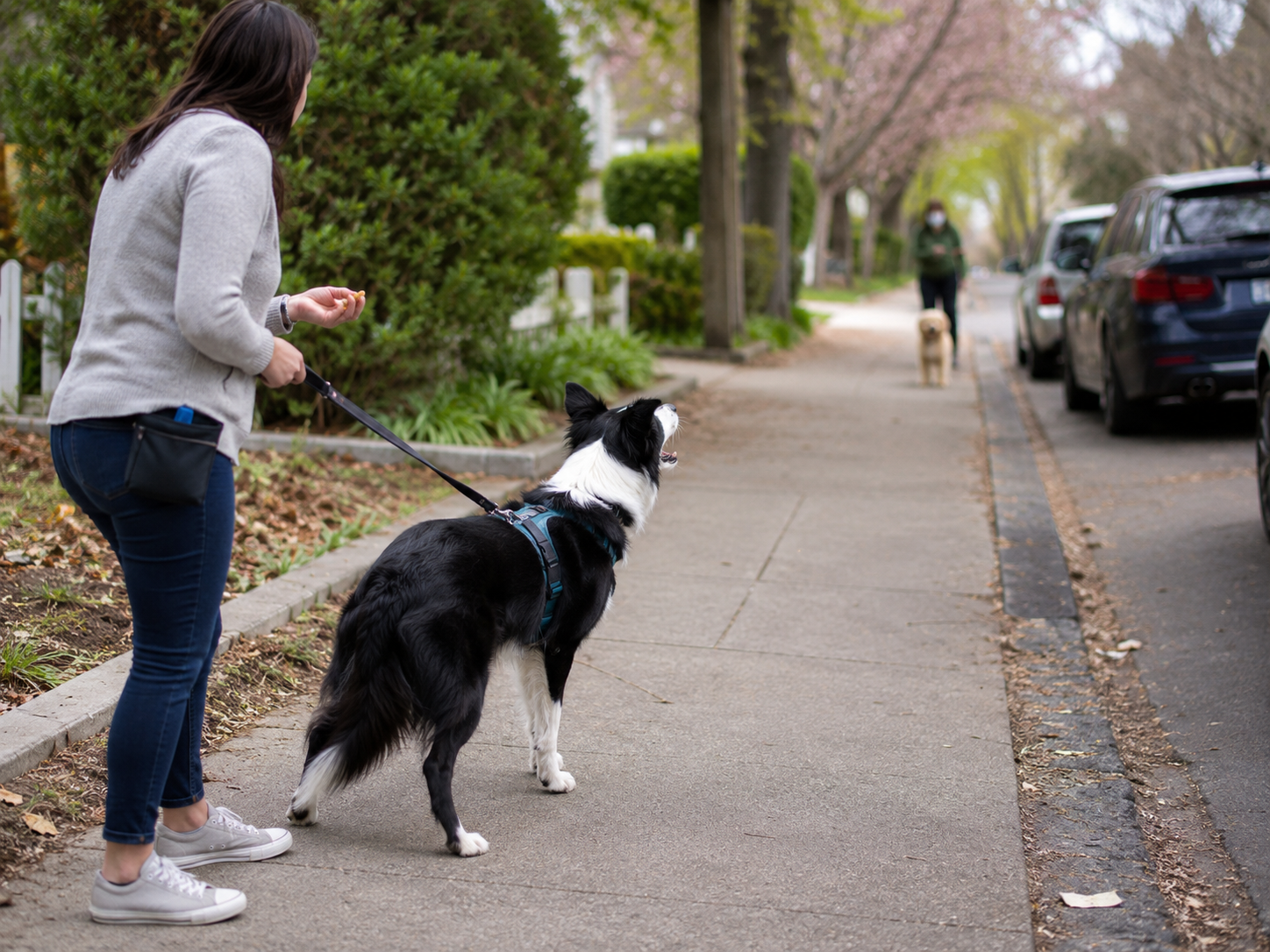
7. How to Reduce Window or Fence Barking
A window can provide dozens of barking rehearsals every day.
A person passes. The dog barks. The person continues down the street. From the dog's perspective, barking may appear to have made the person go away.
Fence barking can develop through a similar pattern.
Begin by changing access to the trigger:
- close curtains during busy times
- use appropriate privacy film where useful
- move furniture away from the window
- create another comfortable resting location
- supervise garden access
- bring the dog indoors before fence barking escalates
Then practice calling the dog away at an easier moment and rewarding disengagement.
Do not wait until the dog has been barking intensely for several minutes before trying the first repetition.
Catching the trigger early makes an alternative response easier to teach.
Back to guide8. Barking at Dogs or People on Walks Often Needs More Distance
Outdoor barking can be driven by fear, frustration, excitement, or a combination of these.
Forcing a reacting dog closer to another dog or person does not necessarily teach confidence.
When the dog is already barking and lunging, learning can become much more difficult.
Use distance proactively:
- cross the road before the reaction begins
- turn onto another route
- use parked vehicles or other safe visual barriers
- avoid narrow spaces when possible
- choose quieter walking times during training
- reward voluntary attention or disengagement
At a manageable distance, the dog can begin learning that seeing the trigger predicts something safe and rewarding rather than a forced confrontation.
Do not force greetings between unfamiliar dogs simply because barking has stopped.
Back to guide
9. Attention-Seeking Barking Can Become a Learned Habit
Some dogs discover that barking makes people respond.
The person looks at the dog, speaks, throws a toy, opens a door, prepares food, or gives another form of attention.
Even irritated attention can sometimes maintain the pattern.
A clearer approach is to:
- make sure the dog's genuine needs have been met
- avoid immediately delivering the requested reward after demand barking
- notice and reinforce appropriate quiet alternatives
- teach a clear behavior for requesting interaction
For example, you might reinforce sitting nearby, bringing a toy quietly, settling on a mat, or another appropriate behavior.
Do not use this strategy for barking caused by pain, fear, separation panic, or another unmet welfare need.
Back to guide10. Boredom and Frustration Need More Than a “Quiet” Command
Some dogs have very limited opportunities to move, sniff, explore, interact, or use normal behaviors.
Adding appropriate exercise and enrichment can improve the overall routine, but barking alone does not prove that a dog is bored.
Review whether the day includes:
- age- and health-appropriate physical activity
- opportunities to sniff and explore
- short reward-based training
- appropriate play
- safe enrichment or foraging
- positive social interaction
- adequate uninterrupted rest
Frustration can also occur when a dog can see something it wants but cannot reach it—for example another dog through a fence or window.
In that case, adding exercise alone may not solve the trigger-response pattern. Environmental management and training are still needed.
Back to guide11. Excitement Barking Often Improves When the Whole Routine Slows Down
Some dogs bark when the leash appears, food is prepared, visitors arrive, play begins, or the car stops at a favorite location.
Instead of trying to shout over the excitement, teach predictable behaviors before the high-arousal event.
For example:
- pause leash attachment until the dog can stand or sit briefly
- reward four paws on the floor before opening a door
- use a mat behavior while food or visitor routines are prepared
- insert brief calm pauses into highly exciting games
- end the activity before arousal becomes unmanageable
Calm does not mean forcing the dog to remain perfectly still for long periods.
Start with very small achievable moments and reinforce them consistently.
Back to guide12. Barking When Home Alone Needs Its Own Investigation
Do not assume that a dog barking after departure is deliberately trying to get the owner to return.
Possible causes include outside sounds, boredom, confinement distress, incomplete adjustment to being alone, and separation-related fear or anxiety.
A safely positioned camera can show whether the dog settles, paces, pants, drools, watches the door, attempts escape, destroys exits, or remains distressed.
Persistent panic is not a simple barking problem
If barking or howling occurs with frantic escape attempts, heavy salivation, inability to settle, destruction near exits, elimination, self-injury, or other significant distress, discuss separation-related behavior with your veterinarian.
Severe separation distress should not be managed by simply leaving the dog to bark until it becomes exhausted.
Back to guide13. Barking at Thunder, Fireworks, or Other Noises May Be Fear-Related
Loud or unpredictable sounds can produce fear responses that include barking, pacing, hiding, trembling, panting, salivation, or attempts to escape.
During a real frightening event, focus first on safety and reducing exposure.
Depending on the situation, this may include:
- moving to a quieter interior area
- closing windows and curtains
- using appropriate background sound
- allowing access to an established safe resting area
- preventing escape through doors, fences, or windows
Controlled sound training should begin at a low enough intensity that the dog remains comfortable and should be paired with positive outcomes.
Severe noise fear can require veterinary treatment and should not be handled by forcing the dog to remain beside the full-intensity sound.
Back to guide14. Teach the Dog What to Do Instead of Barking
“Do not bark” gives the dog very little information about what behavior will work instead.
Alternative behaviors are easier to reinforce because they are observable and specific.
Practice the alternative when conditions are easy before expecting the dog to perform it around a powerful trigger.
Back to guide15. Fear-Related Barking Often Needs Desensitization and Counterconditioning
When barking is rooted in fear or anxiety, the emotional response to the trigger needs attention.
Desensitization means presenting the trigger at a low enough intensity that the dog remains comfortable.
Counterconditioning pairs that manageable trigger with something the dog values, helping create a different emotional association.
For example:
- position the dog far enough from the trigger to remain comfortable
- let the dog notice the trigger
- pair that observation with an appropriate reward
- end or increase distance before the dog becomes highly reactive
- repeat successful sessions
- change distance or intensity gradually over time
Do not use flooding
Flooding means prolonged exposure to a fear-triggering stimulus at an intensity that produces fear. This can worsen fear and has important welfare risks.
If the dog reacts, reduce the intensity during the next repetition instead of forcing the dog to continue.
Back to guide16. Can You Teach a Dog a “Quiet” Cue?
Yes, but a quiet cue works best as one piece of the plan rather than the entire solution.
Start in a low-intensity situation where the dog can pause naturally.
A simple approach is:
- use a mild trigger the dog can handle
- wait for or create a brief pause in barking
- mark and reward the quiet moment
- repeat until pauses become predictable
- introduce the verbal cue around the behavior once the pattern is clear
Do not repeatedly yell “quiet” while the dog is intensely barking and unable to disengage.
If fear is driving the behavior, increasing distance and changing the dog's emotional response are more important than demanding silence.
Back to guide17. Exercise, Enrichment, Sleep, and Routine Support Barking Training
Behavior does not occur separately from the rest of a dog's day.
Appropriate physical activity, sniffing, enrichment, reward-based training, social interaction, and sufficient rest can make the overall routine easier to manage.
But exercise should not be used as a universal cure.
A fearful dog does not necessarily need to be physically exhausted. A dog with separation anxiety does not simply need a longer run. A senior dog in pain may actually worsen with excessive activity.
Build a balanced day around:
- appropriate physical activity
- sniffing and exploration
- mental enrichment
- brief training opportunities
- predictable routines
- adequate quiet rest
Then address the specific barking trigger with its own management and training plan.
Back to guide18. Sudden Barking Changes Can Have a Medical Cause
A dog that suddenly becomes more vocal deserves a broader look than training alone.
Pain can alter behavior. Hearing or vision changes can alter how a dog responds to the environment. Older dogs may develop cognitive changes that affect sleep, orientation, anxiety, and vocalization.
Arrange veterinary advice when new barking occurs with:
- pain, limping, or reluctance to move
- confusion or disorientation
- night-time restlessness
- changes in hearing or vision
- new house soiling
- major changes in sleep
- changes in appetite, drinking, or urination
- sudden aggression or fear
- weakness or other physical signs
- a major unexplained personality change
Do not assume that a senior dog barking unexpectedly is simply becoming “stubborn.”
Back to guide19. What Not to Do When Your Dog Barks Too Much
Avoid these common mistakes:
- shouting repeatedly over the dog
- hitting, frightening, or physically intimidating the dog
- using pain- or fear-based bark-control tools
- using electronic shock collars
- using prong or choke collars as barking corrections
- forcing a fearful dog close to the trigger
- deliberately flooding a dog with a feared stimulus
- punishing fear-related barking
- punishing home-alone barking after returning home
- expecting exercise alone to cure every barking problem
- rewarding demand barking inconsistently
- waiting until the dog is fully over-aroused before intervening
- ignoring sudden barking that may have a medical cause
Punishment may suppress an outward behavior without resolving the fear, anxiety, frustration, or trigger behind it.
In fearful dogs, aversive responses can also increase anxiety and make the situation less safe.
Back to guide20. A Practical Barking-Training Framework
Track progress for one week
Progress does not require complete silence. Better recovery, easier disengagement, and fewer intense episodes are meaningful improvements.
Back to guide21. When to Ask a Veterinarian or Behavior Professional for Help
Some barking problems go beyond ordinary household training.
Contact your veterinarian when barking:
- begins suddenly without an obvious reason
- occurs with pain or physical discomfort
- appears with confusion or night-time disorientation
- changes significantly in an older dog
- occurs with major anxiety or panic
- is associated with self-injury or dangerous escape attempts
- appears with appetite, drinking, urination, sleep, or mobility changes
- is accompanied by a major unexplained behavior change
Qualified behavior support is especially useful when:
- the dog lunges, snaps, or shows aggression around triggers
- fear is severe
- walks or visitors have become difficult to manage safely
- the dog cannot remain calm at any workable distance from the trigger
- home-alone barking appears to be separation distress
- the problem continues despite consistent management and training
- the household is struggling to implement a safe plan
Choose a professional who uses reward-based, evidence-informed behavior methods rather than pain, intimidation, or fear.
Severe aggression, profound fear, self-injury, or complex behavior problems may warrant referral to a veterinary behaviorist.
Back to guideExplore More Daily Dog Care Guides
22. Frequently Asked Questions
How do I stop my dog from barking so much?
First identify the trigger and likely reason for the barking. Reduce unnecessary exposure, then teach and reward an alternative response. Fear-related, separation-related, medical, and attention-seeking barking require different approaches, so one universal technique does not fit every dog.
Should I ignore my dog when it barks?
It depends on why the dog is barking. With some learned attention-seeking barking, avoiding reinforcement while rewarding an appropriate alternative can be useful. Barking caused by fear, pain, severe anxiety, toileting needs, or separation distress should not simply be ignored.
How do I stop my dog barking at people outside the window?
Reduce repeated visual exposure with curtains, privacy barriers, or a different resting location. Then practice calling the dog away and rewarding disengagement when the trigger is still mild rather than waiting for a full barking episode.
How do I stop my dog barking at the doorbell?
First teach a strong alternative such as going to a mat when the house is quiet. Then introduce a low-intensity knock or doorbell sound and reward the alternative behavior. Increase realism gradually and use barriers or distance during unexpected visitors.
Why does my dog bark at other dogs during walks?
Fear, frustration, excitement, or social conflict can all contribute. Increase distance before the reaction begins and reinforce calm observation, attention, or movement away. Avoid forcing close greetings while the dog is reacting.
Can I teach my dog a quiet command?
Yes. Reinforce brief quiet pauses in an easy training situation and attach the cue gradually. A quiet cue is most effective when the barking trigger and emotional cause are also being addressed.
Will more exercise stop my dog barking?
Appropriate exercise and enrichment can improve the daily routine of a dog that lacks suitable outlets, but exercise does not cure every barking problem. Fear, separation anxiety, pain, frustration, and learned barking patterns require their own assessment and plan.
Should I use a bark collar?
Pain- and fear-based suppression methods do not address the reason the dog is barking and can create welfare and behavior risks. Current veterinary behavior guidance favors environmental management and reward-based behavior modification rather than aversive training methods.
Why does my dog bark when left alone?
Possible causes include environmental sounds, confinement distress, boredom, or separation-related anxiety. Video can help reveal what happens after departure. Persistent panic, escape behavior, heavy salivation, or inability to settle should be discussed with a veterinarian.
Why has my senior dog suddenly started barking more?
Changes in pain, hearing, vision, sleep, anxiety, medical health, or cognitive function can alter vocalization in older dogs. A sudden or significant change deserves veterinary assessment rather than being assumed to be a training problem.
When does dog barking need professional help?
Seek help when barking is associated with aggression, severe fear, separation panic, self-injury, dangerous escape attempts, sudden medical or behavior changes, or when consistent reward-based management is not producing safe progress.
23. Veterinary & Behavior Sources
This educational guide was prepared with reference to established veterinary behavior guidance. Sources checked August 13, 2026.
- Merck Veterinary Manual — Behavior Problems of Dogs
- American Animal Hospital Association — Changing Behaviors
- American Animal Hospital Association — Canine and Feline Behavior Management Guidelines
- American Animal Hospital Association — Canine Life Stage Behavior Guidance
- American Veterinary Society of Animal Behavior — Humane Dog Training Position Statement
Veterinary & Behavior Disclaimer
Daily Dog Care Guide provides general educational information for dog owners. This article does not diagnose a medical or behavioral disorder and does not replace veterinary examination, treatment, emergency care, or an individualized behavior-modification plan.
Barking can have learned, environmental, emotional, and medical causes. Contact a qualified veterinarian if barking begins suddenly, occurs with pain or illness, is associated with severe anxiety or aggression, changes significantly in a senior dog, or appears with other major health or behavior changes.
Final Thoughts
The most effective barking plan usually begins before the bark.
Find the trigger. Look at the dog's emotional state. Notice what happens after the barking. Reduce unnecessary opportunities to rehearse the problem.
Then teach something clear and achievable instead.
At the door, that may be moving to a mat. At the window, it may be turning away and coming to you. On a walk, it may be calmly increasing distance. With attention-seeking barking, it may be learning another appropriate way to request interaction.
When fear or anxiety is involved, work below the dog's reaction threshold and change the emotional response gradually rather than trying to suppress the warning signal with punishment.
And when barking changes suddenly, becomes dangerous, appears with aggression or panic, or is accompanied by health changes, look beyond training and involve a veterinarian.
The goal is not a dog that never makes a sound. It is a dog that can communicate, recover, disengage, and respond to everyday triggers without spending large parts of the day trapped in repeated barking.
Back to guideCalm Training & Enrichment Tools
These can support reward-based practice and calm enrichment; they are not a substitute for addressing the cause of persistent behavior problems.
A compact marker-training tool for clear reward-based practice.
View on Amazon →Optional product • paid linkDog Treat Pouch for TrainingKeeps small rewards easy to reach during short training sessions and walks.
View on Amazon →Optional product • paid linkDog Lick Mat with Suction CupsA food-enrichment option for supervised licking activities and calm indoor engagement.
View on Amazon →Affiliate disclosure: As an Amazon Associate I earn from qualifying purchases. Always check size, fit, materials, labels, and your dog’s individual needs before buying.
Helpful next steps
Continue with a related guide, tool, or product resource.