How to Stop a Dog From Jumping on People
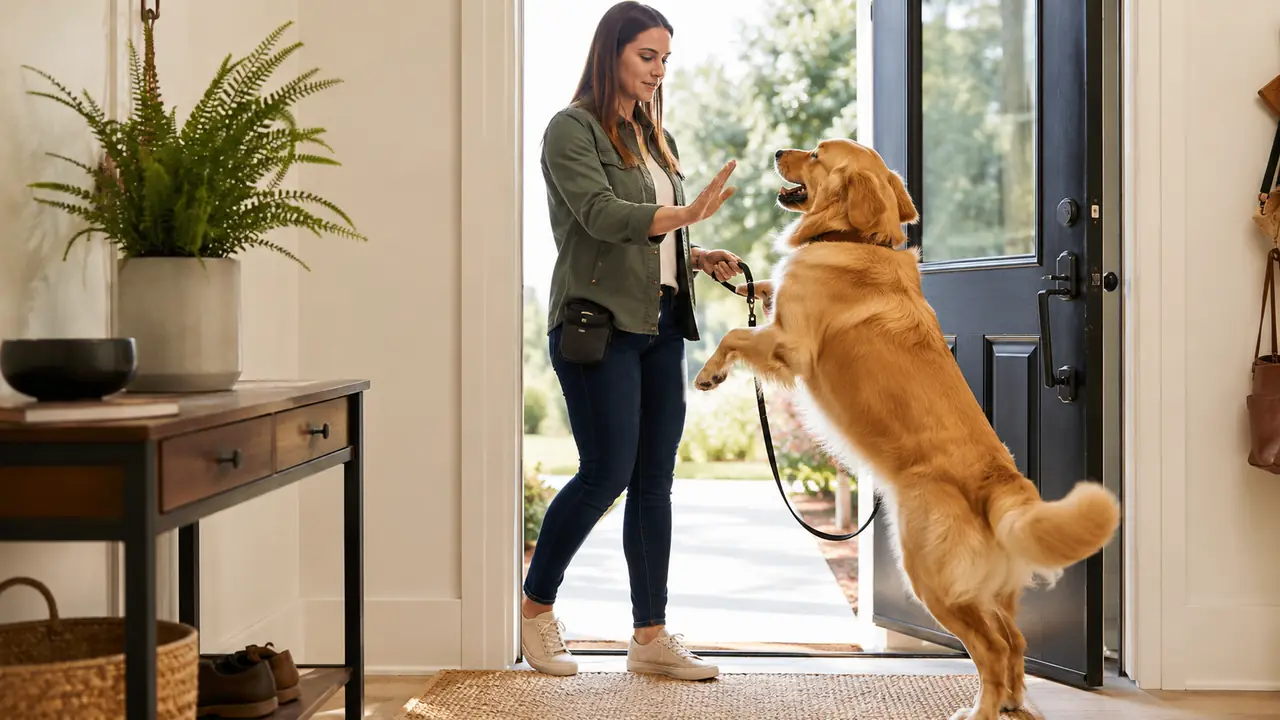
Dogs often jump because greeting people is rewarding and exciting. Instead of punishing the jump, make greetings easier to manage and teach a behavior that earns the attention the dog wanted—four paws on the floor, a calm approach, a sit, or moving to a familiar mat.
Updated August 13, 2026 · Veterinary behavior sources checked
Around children, older adults, people with balance problems, or anyone uncomfortable with dogs, physical management comes before greeting practice.
A dog can be genuinely delighted to see somebody and still make the greeting unsafe.
A young puppy jumping toward a person's hands may look harmless. If the puppy receives petting, laughter, eye contact, or excited voices, jumping can quickly become part of the normal greeting routine.
As the dog grows, the same behavior may scratch skin, muddy clothing, knock objects from someone's hands, frighten visitors, or cause a person to lose balance.
The useful question is not simply, “How do I stop the jump?”
It is: “What should my dog do instead, and how can I make that behavior more rewarding than jumping?”
This guide shows you how to prevent repeated jumping, reinforce calm approaches, manage real visitors, practice outside the home, protect vulnerable people, and recognize when jumping is part of a more complex fear, arousal, or aggression problem.
Quick Answer: How Do You Stop a Dog From Jumping on People?
Prevent the dog from repeatedly rushing into uncontrolled greetings, then consistently reward the behavior you want instead.
Four paws on the floor can earn attention, food rewards, petting, or access to the visitor. Jumping should not be what makes the greeting continue.
Practice with easy situations before real visitors arrive. A leash, gate, distance, or trained mat behavior can help prevent the dog from rehearsing the jump while learning.
Avoid pushing, kneeing, shouting, leash corrections, or other physical punishment. These methods can add attention or arousal and do not clearly teach the dog what behavior should replace jumping.
If jumping occurs with growling, snapping, intense fear, frantic mouthing, inability to settle, or another safety concern, use management and seek qualified behavior help.
Why Dogs Jump on People
In This Calm Greeting Guide
1. Why Jumping Becomes a Habit
Behaviors that produce useful consequences are likely to be repeated.
Imagine a puppy that jumps when somebody arrives.
The person immediately looks down, says the puppy's name, touches the puppy, and laughs.
From the puppy's perspective, jumping successfully produced social attention.
Even reactions intended to discourage jumping can sometimes become part of that reinforcement history.
Pushing the dog away, talking loudly, grabbing at the dog, or repeatedly saying “off” may still provide touch, movement, eye contact, and social engagement.
The clearest plan is therefore to stop letting jumping be the reliable route to greeting and teach a different route instead.
Back to guide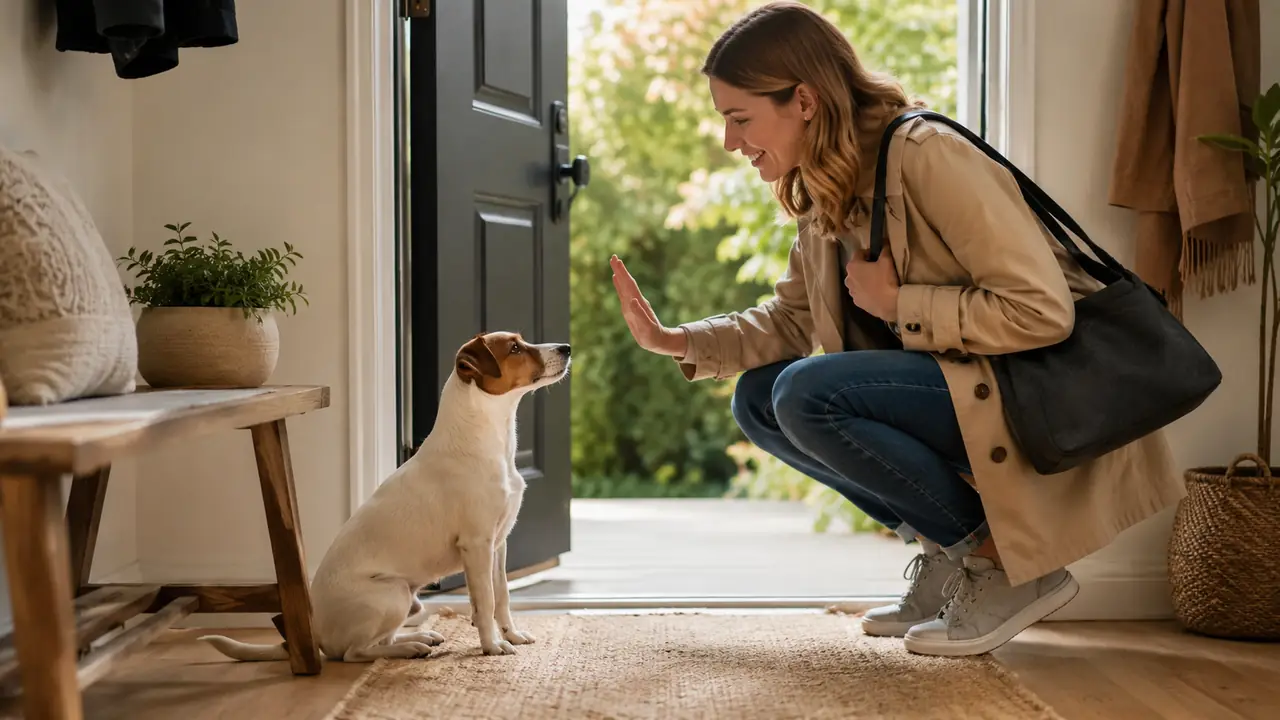
2. Not Every Jump Means “I Am Happy to See You”
Many dogs jump because they are social and excited, but owners should still look at the whole dog.
A worried or conflicted dog may approach and jump while also barking, retreating, becoming stiff, mouthing, showing avoidance, or struggling to tolerate touch.
Watch for the wider picture:
- Is the body loose or stiff?
- Does the dog repeatedly approach and retreat?
- Can the dog disengage from the visitor?
- Does touching make the dog more uncomfortable?
- Is there growling, snapping, hard staring, or defensive barking?
- Does the dog appear frightened rather than simply excited?
If fear or aggression may be involved, do not ask unfamiliar people to repeatedly approach the dog as greeting practice.
Increase safety and distance and get qualified guidance.
Back to guide3. Teach One Clear Rule: Calm Feet Make Greetings Happen
The rule does not have to be complicated.
Four paws on the floor can make attention happen. Jumping does not move the greeting forward.
This means you actively reinforce the calm behavior rather than spending the entire lesson correcting the unwanted one.
Possible rewards include:
- a small food reward
- calm verbal praise
- gentle petting if the dog enjoys it
- permission to approach the visitor
- access through a doorway
- a toy or another appropriate activity
For many dogs, access to the person is itself a powerful reward.
Use that carefully: calm feet allow the person to remain available; jumping pauses or interrupts the greeting.
Back to guide4. Prevent Repeated Jumping While the Dog Is Learning
Training is much harder if the dog gets dozens of uncontrolled jumping repetitions each week.
Management prevents those rehearsals.
Do not leave a dog tethered or leashed unattended
Leashes and barriers are management tools for supervised situations. Choose a setup that does not create entanglement, escape, or confinement distress.
Management is particularly important around people who could be injured by even one friendly jump.
Back to guide5. Teach Four Paws on the Floor Before Practicing With Visitors
Start in an easy environment.
You do not need a doorbell, a visitor, and a highly excited dog for the first lesson.
Short, successful sessions are more useful than repeatedly allowing the dog to become too excited to perform the behavior.
Back to guide6. Does the Dog Have to Sit Before Greeting?
No.
A sit can be a useful alternative behavior, but it is not the only polite greeting.
Some dogs find it easier to stand with four paws on the floor. Others do well going to a mat and approaching only after they settle.
Choose the alternative the individual dog can perform reliably and comfortably.
Avoid turning the lesson into an endless cycle of sit → greet → jump → sit → greet → jump. If excitement is increasing, create more distance or end the greeting.
Back to guide7. What If Your Dog Jumps on You When You Come Home?
Your arrival may be one of the strongest greeting triggers because the dog has been waiting for you.
Prepare before opening the door fully if you know the dog is likely to rush.
A simple arrival pattern can be:
- enter calmly
- avoid immediately creating a highly physical greeting
- reinforce paws on the floor or another familiar greeting behavior
- pause the greeting if jumping resumes
- continue attention when calm behavior returns
You do not need to ignore your dog for a long period.
The lesson is simply that calm approaches make social interaction easier to access than jumping.
Back to guide8. A Safer Greeting Routine for Visitors at the Door
The front door combines several difficult events: a bell or knock, owner movement, a door opening, a new person entering, and immediate social excitement.
Do not expect an untrained dog to solve all of those pieces at once.
9. Tell Visitors Exactly How They Can Help
Training becomes confusing if the household has one rule but every visitor has a different one.
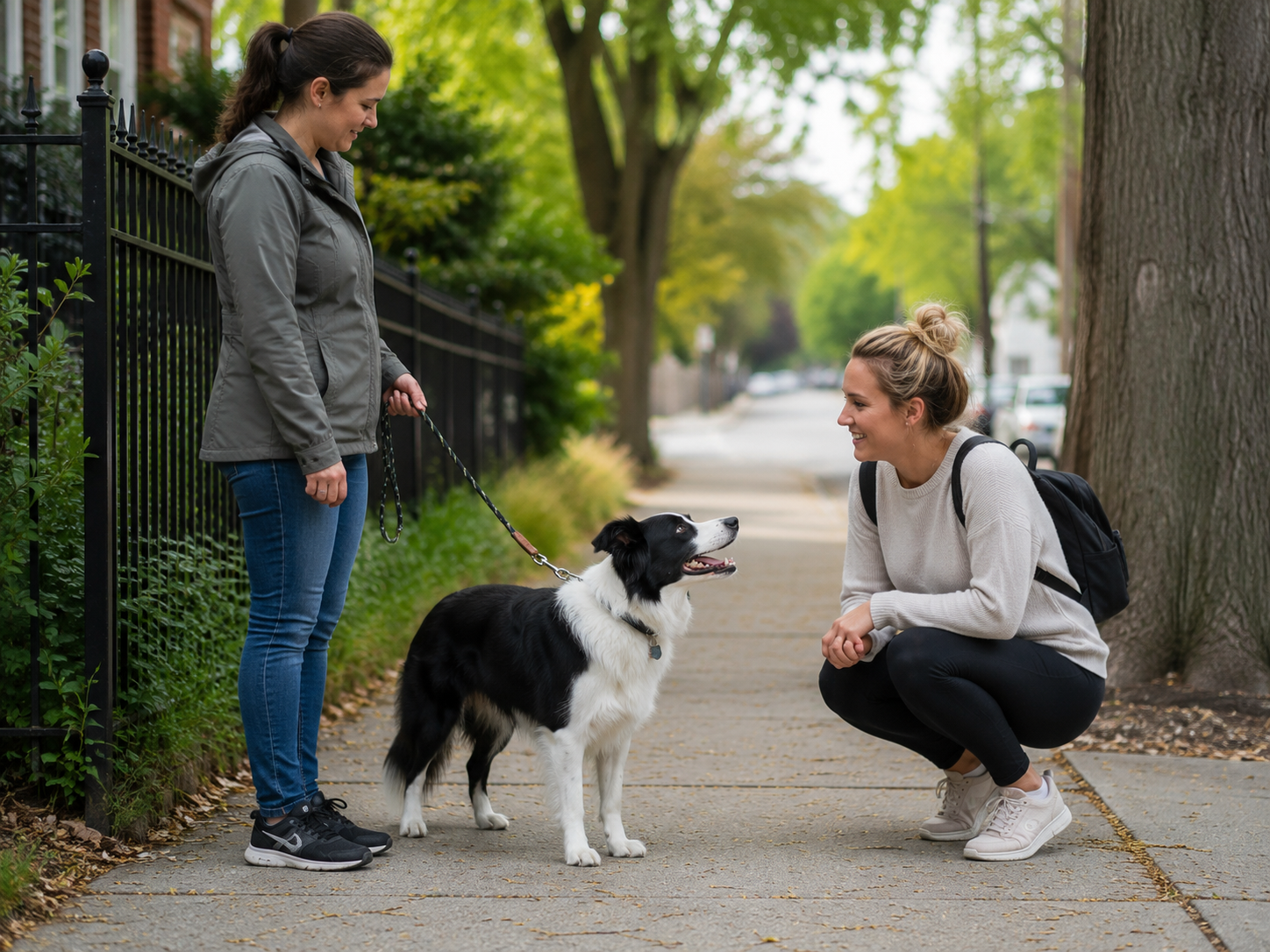
Before the visitor approaches, explain the plan briefly.
You can say:
“We are teaching calm greetings. Please wait until all four paws are on the floor before giving attention.”
Ask visitors to:
- avoid immediately exciting the dog with loud voices
- avoid bending over the dog if that increases jumping
- avoid waving hands around the dog's face
- pause attention if the dog jumps
- give calm attention when paws are down
- follow your instructions about whether greeting should occur at all
A visitor saying “I don't mind jumping” does not mean you need to abandon the training plan.
The next visitor may be a child, an older adult, or somebody who is afraid of dogs.
Back to guide10. Dogs Do Not Need to Greet Every Person During a Walk
Outdoor greetings are often more difficult because the dog is already processing smells, traffic, people, animals, and movement.
If your dog becomes overexcited when strangers approach, declining the greeting is completely reasonable.
A simple phrase is:
“We're training today, so we're not greeting.”
For planned greetings:
- begin with enough space for the dog to remain responsive
- reinforce four paws on the ground before approaching
- approach for only a short greeting
- move away calmly if jumping begins
- reward successful disengagement
If the dog is fearful of strangers, jumping toward people can be part of a more complex response. Do not use repeated stranger greetings as forced exposure.
Back to guide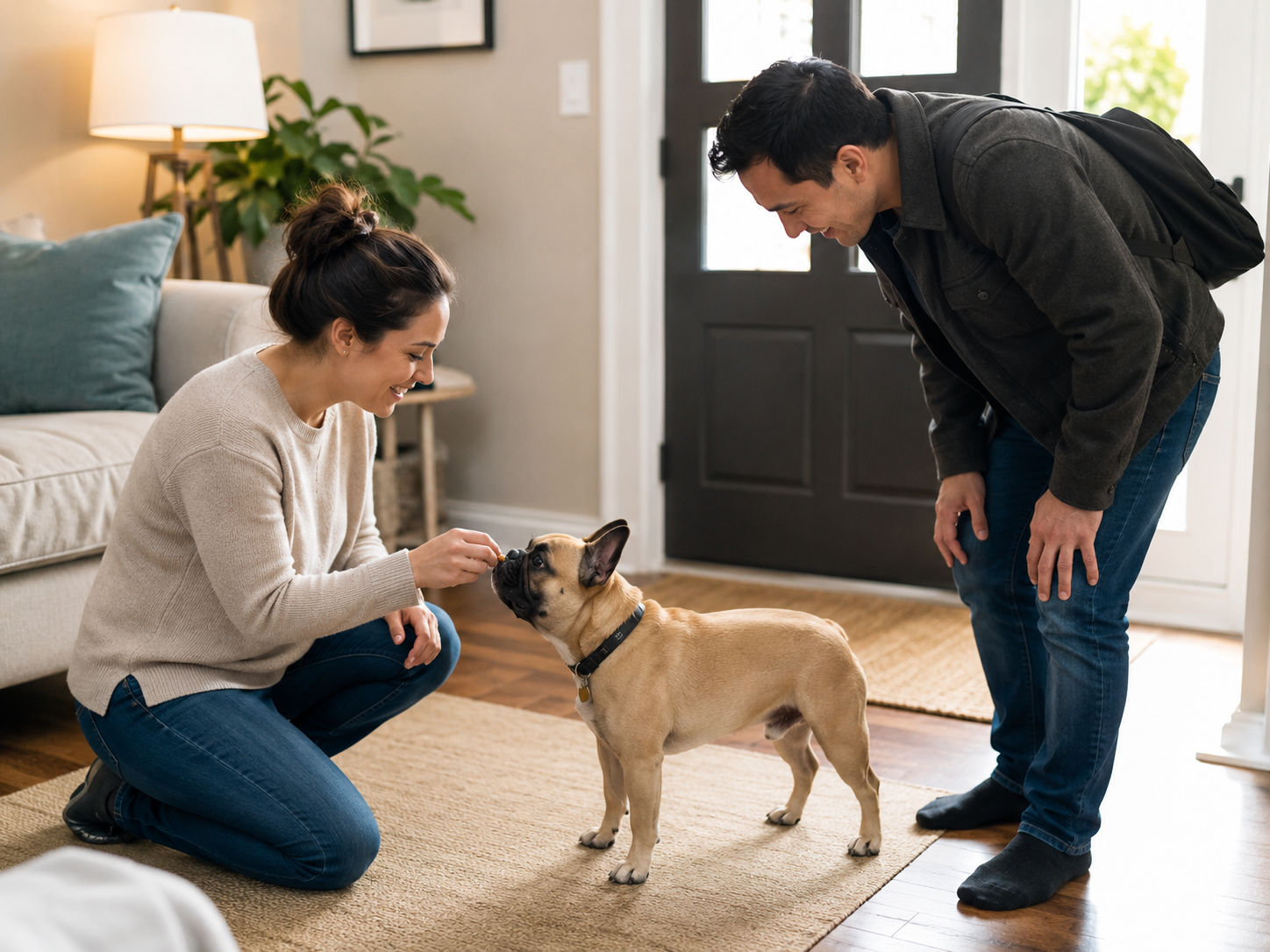
11. Teach Puppies Calm Greetings Before Jumping Becomes Well Practiced
Puppy jumping is often unintentionally rewarded because small puppies are easy to pick up, cuddle, laugh at, and pet while they bounce.
Those same repetitions become much less convenient when the dog is larger.
Build good habits early:
- reward approaches with paws on the floor
- keep greeting sessions short
- prevent children and visitors from encouraging jumping
- practice with familiar people before busy social situations
- teach a mat, stand, or sit as an alternative
- give puppies sufficient rest between exciting activities
Puppies do not need physical corrections for jumping.
They need clear reinforcement, management, repetition, and age-appropriate expectations.
Back to guide12. Protect Children, Older Adults, and People With Balance Problems
A friendly dog can cause an injury without intending harm.
Children are smaller, and some older adults or people with disabilities may be especially vulnerable to losing balance.
Do not instruct children to knee, push, grab, or physically correct a jumping dog.
If the dog cannot yet greet safely, separation is the correct choice.
Back to guide13. Large or Powerful Dogs Need Management Before Perfect Training
With a strong dog, simply turning your back and hoping the jumping stops may not be physically safe.
The dog can still knock a person forward, scratch the back, or jump again from another angle.
Use barriers, controlled distance, and a supervised leash so jumping cannot repeatedly make contact with the person.
Train the alternative response separately where you can reward success without anybody being knocked over.
Safety is not the same as punishment
Preventing a large dog from reaching a vulnerable visitor is responsible management. The dog can learn the greeting skill at an easier level instead.
14. Jumping With Mouthing, Clothing Grabs, or Wild Play Needs Extra Care
Some excited dogs combine jumping with grabbing sleeves, hands, bags, clothing, or the leash.
This may occur because arousal has become very high, because mouthing has been reinforced during play, or because the dog has not learned another way to manage the greeting.
Reduce the difficulty:
- prevent direct access during the first part of arrivals
- use barriers or distance
- practice calm behaviors without a visitor first
- keep greetings extremely short
- end interaction before arousal becomes unmanageable
- avoid wrestling, grabbing the muzzle, or physical confrontation
If mouthing is forceful, causes injury, occurs with stiff or threatening behavior, or progresses to snapping or biting, get qualified behavior help.
Back to guide15. Sometimes the Dog Needs Less Excitement Before More Training
A dog at very high arousal may struggle to perform a behavior that is easy in the living room.
If a visitor enters and the dog cannot respond, keeps jumping immediately, grabs clothing, or races around, reduce the difficulty.
Possible adjustments include:
- allow the visitor to enter while the dog is separated
- wait before attempting a greeting
- increase distance
- use a familiar mat or search activity if appropriate
- practice with a quieter visitor
- shorten the greeting
The objective is not to exhaust the dog before every visitor arrives.
Appropriate exercise and enrichment support normal behavior, but successful greeting training still requires practice around manageable levels of excitement.
Back to guide16. Household Consistency Can Decide Whether the Training Works
Jumping becomes resistant to change when it is rewarded only sometimes.
If one person rewards four paws on the floor but another person happily pets the dog while it jumps, the dog still has a reason to keep trying the jump.
Agree on one household plan:
- what behavior earns a greeting
- what happens when the dog jumps
- where the dog waits when visitors enter
- who handles the leash or gate
- whether visitors are allowed to greet
- what reward will be used
Simple, repeatable rules are easier for both people and dogs.
Back to guide17. Jumping Can Briefly Become More Persistent When Attention Stops
A behavior that used to work may initially be tried more intensely when the old reward disappears.
For example, a dog that has repeatedly been petted for jumping may jump again, jump higher, or try several times when that attention suddenly stops.
This is one reason owners sometimes think the new plan is failing after only a few attempts.
However, simply waiting through repeated jumping is not appropriate when a person could be injured.
Use management to prevent contact, and actively reinforce the alternative behavior.
The safest strategy is not:
“Ignore unlimited jumping until the dog eventually stops.”
It is:
“Prevent unsafe jumping, remove the old payoff, and make the new calm behavior easy and rewarding.”
Back to guide18. Common Mistakes When Trying to Stop Dog Jumping
Avoid these common problems:
- kneeing the dog in the chest
- pushing the dog repeatedly with your hands
- shouting or physically intimidating the dog
- using leash jerks or painful corrections
- allowing some people to reward jumping
- waiting for real visitors before practicing
- allowing a large dog to repeatedly knock people over
- demanding long sits when the dog is too excited to succeed
- letting strangers rush toward a nervous dog
- forcing every dog to greet every visitor
- making children manage a jumping dog
- continuing a greeting after arousal is clearly escalating
- assuming every jump is friendly excitement
Reward-based training does not mean giving the dog unlimited access to people.
Clear boundaries, gates, leashes, distance, and temporarily ending a greeting can all be part of humane management.
Back to guide19. A Practical Calm-Greeting Training Plan
Track these signs of progress:
- fewer jumping attempts
- shorter recovery time after a person arrives
- more spontaneous four-paws-down approaches
- better response to the mat or greeting cue
- ability to greet briefly and disengage
- less need for physical management over time
Progress does not have to mean perfect greetings immediately.
Fewer unsafe repetitions and more successful calm approaches are meaningful improvements.
Back to guide20. Sudden Changes in Greeting Behavior Can Need a Veterinary Check
A dog that has always greeted normally but suddenly becomes unusually frantic, irritable, fearful, defensive, or difficult to handle deserves a broader assessment.
Pain, sensory changes, neurologic problems, cognitive changes, and other health conditions can alter behavior.
Contact your veterinarian when greeting changes occur with:
- pain or sensitivity to touch
- limping or mobility changes
- confusion or disorientation
- sudden new fear
- unexplained aggression
- major sleep changes
- changes in appetite or drinking
- weakness or other physical signs
- a major unexplained personality change
Training should not be used to cover up a sudden behavior change that may have a medical cause.
Back to guide21. When to Get Professional Training or Behavior Help
Ordinary friendly jumping can often improve with consistent reward-based training and management.
Professional help is particularly useful when:
- the dog repeatedly knocks people down
- you cannot physically manage the dog safely
- jumping includes hard mouthing or clothing grabs
- the dog growls, snaps, or threatens visitors
- the dog appears frightened of people
- the dog cannot settle enough for normal training
- children or vulnerable adults live in or visit the home
- the behavior is worsening
- consistent training has not produced safe progress
Choose a professional who uses reward-based, evidence-informed methods.
Aggression, profound fear, self-injury, or complex behavior problems may warrant veterinary assessment and referral to a veterinary behaviorist.
Back to guideExplore More Daily Dog Care Guides
22. Frequently Asked Questions
How do I stop my dog from jumping on people?
Prevent uncontrolled jumping when possible, consistently reward four paws on the floor or another chosen greeting behavior, and make access to people depend on calm behavior rather than jumping. Practice first in easy situations and add visitors gradually.
Why does my dog jump on guests but not on me?
Guests may be more novel and exciting, and they may react differently from household members. Some visitors also unintentionally reward jumping with talking, touching, laughing, or pushing.
Should I turn my back when my dog jumps?
With a small, manageable dog in a safe training situation, briefly removing social attention can be part of the plan. It should not be the only strategy, and it may be unsafe with a large or forceful dog. Use barriers, distance, or a leash to prevent injury and actively reward the alternative behavior.
Should I knee my dog when it jumps?
No. Physical corrections do not clearly teach the desired greeting and can create fear, conflict, pain, or increased arousal. Reward-based training and management provide a safer teaching strategy.
Should my dog sit before every greeting?
Not necessarily. A sit is useful for some dogs, but four paws on the floor, standing calmly beside you, or going to a mat can also be appropriate greeting behaviors.
Why does pushing my dog away make it jump again?
Pushing can still provide touch, movement, eye contact, or play-like interaction. If the dog values that response, jumping may continue. Prevent the jumping when possible and make calm behavior the reliable way to access attention.
How do I stop my puppy from jumping?
Reward the puppy frequently for approaching with paws on the floor, manage exciting greetings, keep practice brief, and ask family members and visitors not to reward jumping. Early consistency prevents the puppy from building a long history of successful jumping.
What should visitors do when my dog jumps?
Tell visitors the plan before they approach. They should avoid giving exciting attention during the jump and provide calm interaction when the dog performs the chosen greeting behavior. Use a gate, leash, or distance if direct contact is not yet safe.
Should my dog greet every stranger on walks?
No. Your dog does not need to greet everybody. Skipping greetings can make training easier and is particularly appropriate when the dog is overexcited, fearful, or difficult to manage.
What if my dog jumps and bites or grabs clothing?
Reduce direct access and use physical management such as gates, distance, or a supervised leash. Forceful mouthing, injuries, stiff body language, growling, snapping, or escalating behavior should be assessed by a qualified reward-based behavior professional and, when appropriate, a veterinarian.
How long does it take to stop a dog from jumping?
There is no fixed timetable. Progress depends on how long the behavior has been reinforced, the dog's arousal level, how consistently people respond, and how often successful practice occurs. Focus on fewer jumping attempts and more reliable calm greetings rather than a specific number of days.
When does jumping need professional help?
Get help when the dog is difficult to control safely, knocks people down, mouths forcefully, shows fear or aggression, jumps on vulnerable people, or fails to improve despite consistent reward-based management and training.
23. Veterinary & Behavior Sources
This educational guide was prepared with reference to established veterinary behavior and reward-based dog-training guidance. Sources checked August 13, 2026.
Veterinary & Behavior Disclaimer
Daily Dog Care Guide provides general educational information for dog owners. This article does not diagnose a medical or behavioral disorder and does not replace veterinary examination, treatment, emergency care, or an individualized behavior-modification plan.
Jumping may occur with excitement, learned attention seeking, fear, conflict, or other behavior patterns. Contact a qualified veterinarian if greeting behavior changes suddenly, occurs with pain or illness, or is accompanied by significant fear, aggression, confusion, or other health changes.
Final Thoughts
A dog does not need to stop enjoying people in order to learn better greetings.
The goal is to give excitement a safer pattern.
Prevent uncontrolled rushing when necessary. Practice before visitors arrive. Reward four paws on the floor. Use a sit, stand, or mat when that behavior helps the individual dog.
Keep visitors consistent and remember that greeting is optional. Around children, older adults, or people with balance problems, management comes before training.
Avoid turning the interaction into a physical contest. Kneeing, pushing, shouting, or painful corrections do not provide the clear alternative behavior the dog needs.
Instead, make the lesson simple:
Calm feet make good things happen.
With enough successful repetition, the dog can still greet people with enthusiasm—without using its entire body to say hello.
Back to guideCalm Training & Enrichment Tools
These can support reward-based practice and calm enrichment; they are not a substitute for addressing the cause of persistent behavior problems.
A compact marker-training tool for clear reward-based practice.
View on Amazon →Optional product • paid linkDog Treat Pouch for TrainingKeeps small rewards easy to reach during short training sessions and walks.
View on Amazon →Optional product • paid linkDog Lick Mat with Suction CupsA food-enrichment option for supervised licking activities and calm indoor engagement.
View on Amazon →Affiliate disclosure: As an Amazon Associate I earn from qualifying purchases. Always check size, fit, materials, labels, and your dog’s individual needs before buying.
Helpful next steps
Continue with a related guide, tool, or product resource.