First Week With a New Puppy: What to Do in the First 7 Days

Your puppy's first week is not about teaching every command or creating a perfect schedule. It is about helping a young dog feel secure while you establish sleep, toilet, feeding, handling, training, and socialization routines one small step at a time.
Updated August 13, 2026 · Prepared with reference to veterinary guidance
The first week with a new puppy can be joyful and exhausting at the same time. Your puppy may sleep peacefully for an hour, wake and need a toilet break, chew the wrong object, become excited, then fall asleep again.
That does not mean the first week is going badly. A young puppy has entered a completely new environment and is learning where to sleep, where to toilet, what is safe to chew, who the people are, and what the daily rhythm feels like.
This guide focuses specifically on what to do after your puppy arrives. Instead of another shopping or preparation checklist, it gives you a practical Day 1 through Day 7 framework.
The exact timetable will vary with age, breed, health, background, and personality. Use the seven days as a flexible sequence of priorities, not a strict rule that every puppy must follow.
Quick Answer: What Should You Do During the First Week With a New Puppy?
Keep the first week calm and predictable. Give your puppy a secure place to sleep, frequent opportunities to toilet, appropriate food and fresh water, short periods of gentle play and positive training, and plenty of uninterrupted rest.
Supervise closely and limit access to parts of the home that are not yet puppy-safe. Reward appropriate behavior rather than waiting for mistakes and then punishing them.
Introduce handling, brief independence, visitors, new sounds, surfaces, and other social experiences gradually and positively rather than overwhelming the puppy.
Arrange veterinary care so your puppy's health records, nutrition, vaccinations, parasite prevention, growth, and individual risk factors can be reviewed.
Your First 7 Days at a Glance
In This First-Week Guide
Before Day 1: Prepare a Simple Landing Zone
Your puppy does not need immediate access to the whole house. A smaller supervised area makes it easier to manage toilet training, chewing, sleeping, and safety.
If you are using a crate, introduce it through positive association. Allow the puppy to explore it voluntarily and build comfort rather than using force or treating the crate as punishment.
Back to guideDay 1: Make Arrival Calm and Predictable
The first day has one main purpose: help your puppy begin to feel safe in the new environment.
Give your puppy a toilet opportunity when you arrive, then introduce a small puppy-safe area of the home.
Offer water and the puppy's normal food according to the routine you were given. Keep introductions calm and avoid a large welcome party.
Allow the puppy to rest instead of encouraging continuous play.
Day 1 priorities
- show the planned toilet area
- offer fresh water
- keep food familiar where practical
- limit exploration to supervised safe areas
- keep visitors and excitement manageable
- begin learning the puppy's body language
- provide frequent opportunities to sleep
Training on the first day can be as simple as pairing the puppy's name with pleasant attention and rewarding the puppy for voluntarily coming toward you.
Back to guide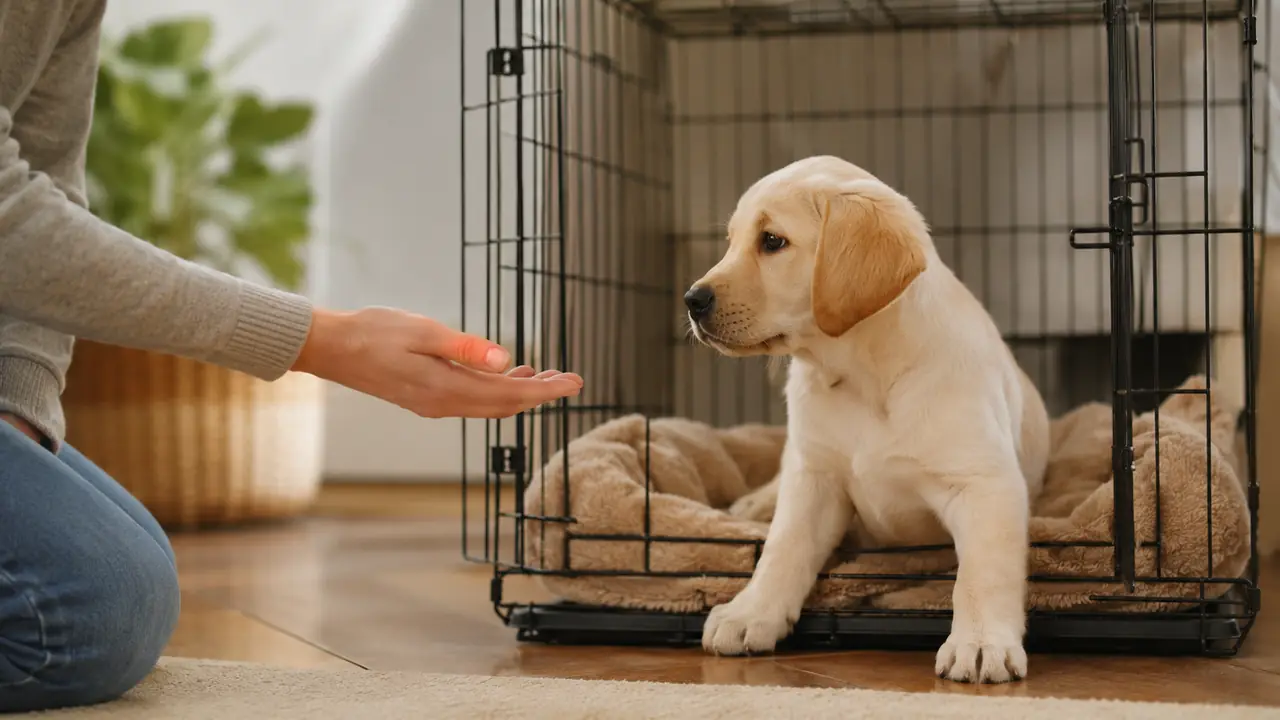
Night 1: Expect the Sleeping Routine to Be New
A puppy may be sleeping without familiar littermates or previous household sounds for the first time. Some puppies settle quickly; others vocalize or wake during the night.
Give your puppy a toilet opportunity before bedtime and keep the final part of the evening calm.
If the puppy wakes, consider whether a toilet trip is needed. Keep nighttime trips quiet and low-key rather than turning them into play sessions.
If you use a crate, the goal is to build a positive association with it. Do not use frightening force or expect a distressed puppy to simply "cry it out" as the method for teaching crate comfort.
Some families initially keep the puppy's sleeping area near enough to hear and monitor the puppy, then make gradual changes later according to their long-term plan.
Back to guideDay 2: Start Building a Predictable Daily Rhythm
Puppies learn from repetition. Begin creating a familiar order to the day: wake, toilet, meal when scheduled, toilet, short activity, rest.
Repeat this general rhythm according to your puppy's age, feeding plan, toilet needs, and sleep.
A useful rhythm may look like this
- wake up
- toilet opportunity
- scheduled meal
- another toilet opportunity
- short play or exploration
- rest
- short positive training
- rest again
The exact times will vary. Watch your puppy rather than forcing every puppy into the same internet schedule.
Begin gentle handling
During calm moments, briefly touch paws, ears, collar area, coat, and body, pairing the experience with something pleasant when appropriate.
Keep sessions short and stop or make the exercise easier if your puppy is becoming uncomfortable.
Back to guideDay 3: Start Reading Your Puppy’s Patterns
By the third day, you may begin noticing when toilet accidents happen, when the puppy becomes mouthy, which resting place works best, and what helps the puppy settle.
These observations are useful because good management begins before the problem occurs.
Questions to ask yourself
- Does the puppy usually need to toilet soon after a meal or drink?
- Does mouthing become stronger when the puppy is tired?
- Which toys hold the puppy's attention safely?
- Where does the puppy settle most easily?
- Is the puppy eating and drinking normally?
- What situations seem to cause hesitation or fear?
Recording these patterns for a few days can make your routine easier to adjust.
Back to guide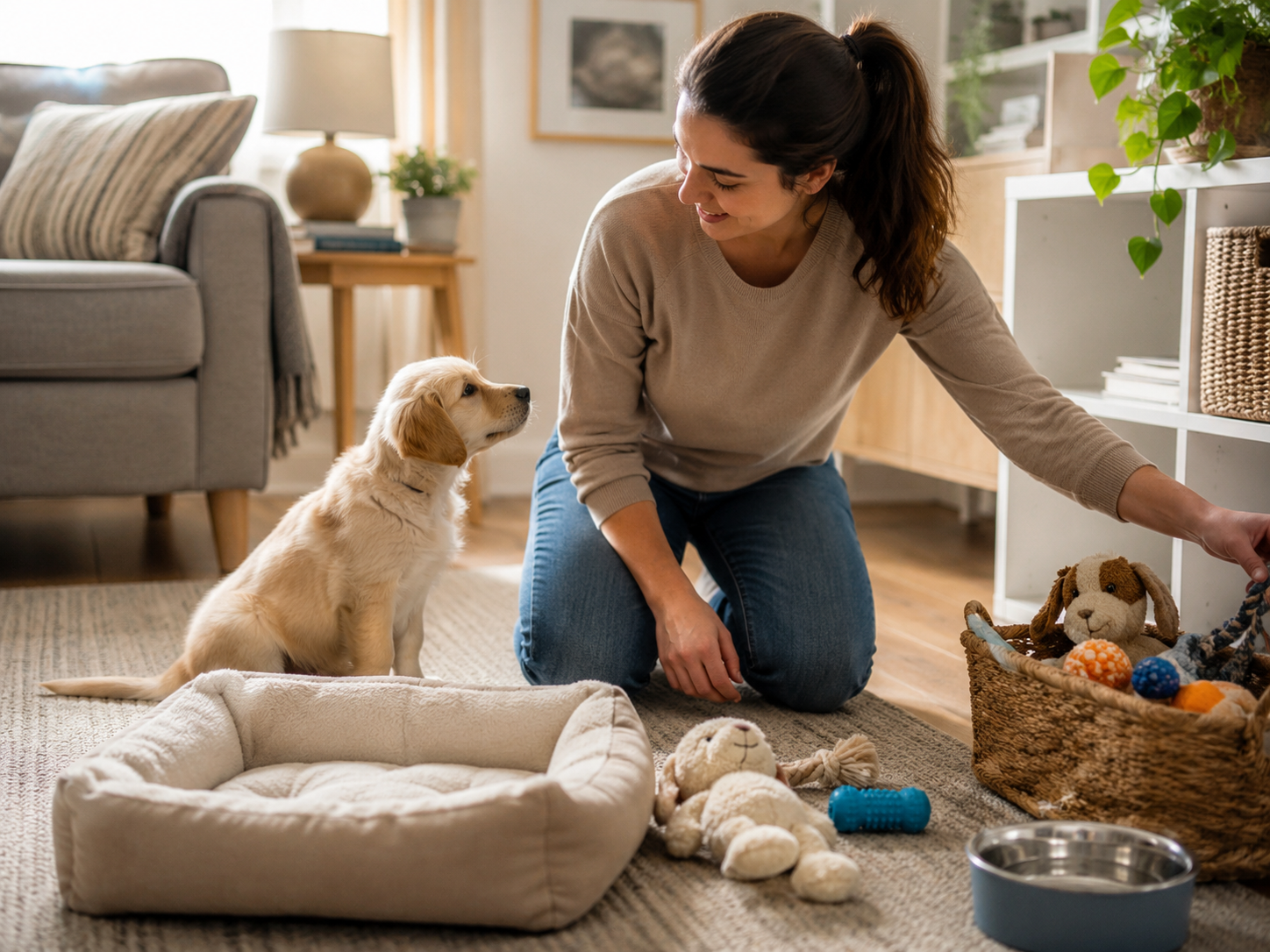
Day 4: Introduce Tiny, Low-Stress Independence
If your puppy is beginning to settle comfortably, you can start very small independence exercises.
The objective is not to leave a young puppy alone for a long period. It is to make tiny, manageable separations ordinary rather than dramatic.
For example, allow your puppy to relax with a safe activity while you move a short distance away or briefly step out of view, then return calmly before the exercise becomes overwhelming.
Increase difficulty gradually based on the puppy's response. If your puppy becomes very distressed, make the next practice easier rather than forcing a prolonged separation.
Do not make every departure or return into a highly emotional event.
Back to guideDay 5: Add More Short, Positive Training
By now you may be able to add several very short training moments throughout the day.
Keep them easy enough that the puppy can succeed.
Useful first-week skills
- responding to the puppy's name
- coming toward you when invited
- following a food lure
- settling briefly on a mat or bed
- accepting gentle handling
- wearing a properly fitted collar or harness comfortably
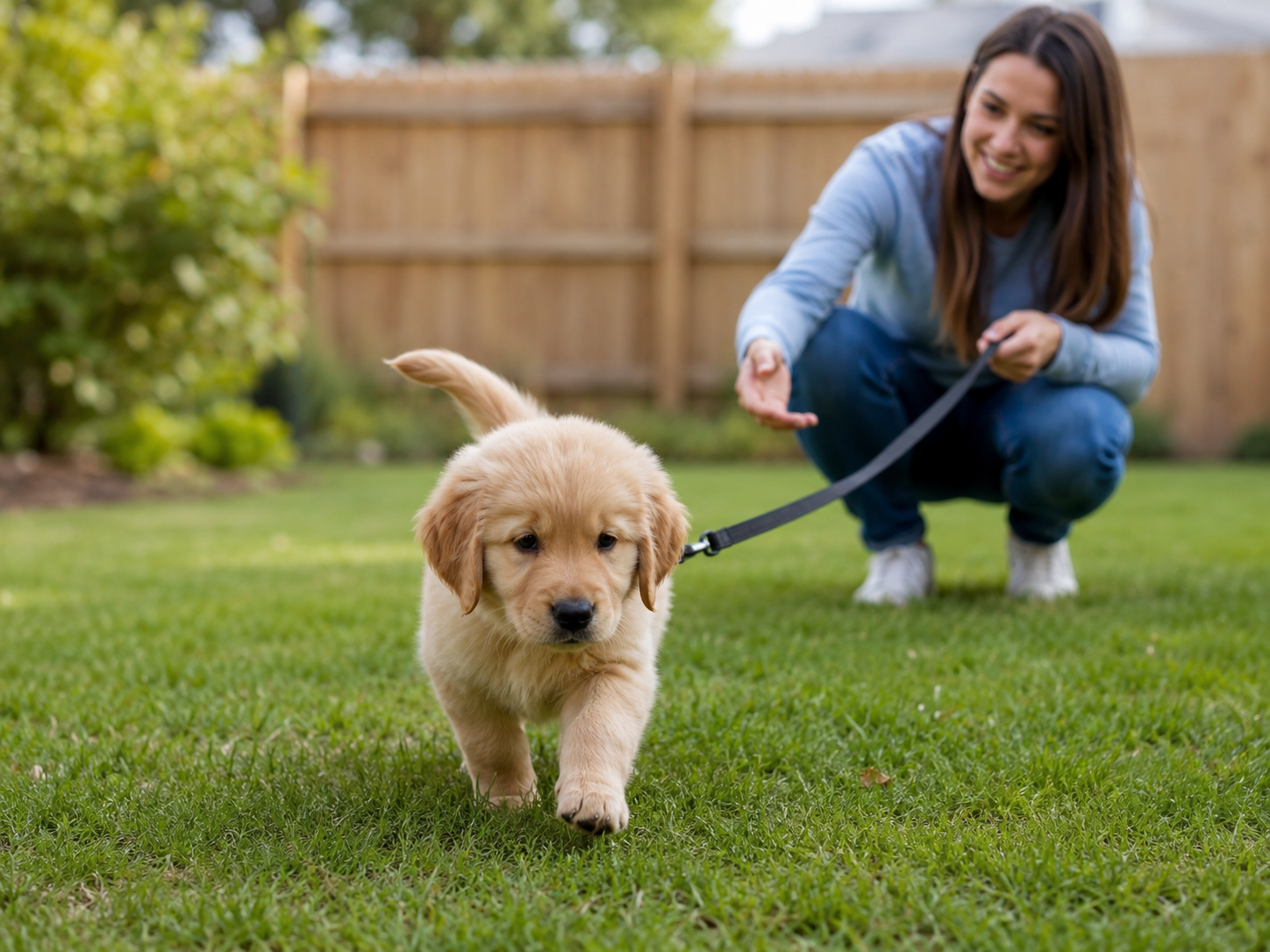
- walking a few relaxed steps with a leash in an appropriate safe area
- trading an inappropriate object for a safe item
Reward-based training helps you show the puppy which behaviors are useful without relying on fear or physical intimidation.
End the session while it is still going well. A few successful repetitions can be more useful than a long session with a tired puppy.
Back to guideDay 6: Build Confidence With Positive Social Experiences
Puppy socialization means creating positive experiences with the world, not forcing the puppy to interact with every person, dog, sound, or place.
Positive first-week experiences may include
- normal household sounds at comfortable levels
- different safe walking surfaces
- gentle body handling
- a calm visitor
- brief car-related practice
- grooming tools introduced gradually
- seeing the world from a safe distance
- appropriate contact with healthy dogs when advised as safe
Early social experiences are important, but infectious-disease risk also matters. Ask your veterinarian which puppy classes, dogs, and environments are appropriate based on your puppy's health, vaccination status, and local disease risks.
Positive socialization should allow the puppy to remain comfortable. If the puppy is frightened, create more distance or reduce the intensity rather than forcing interaction.
Children and the new puppy
Children should learn that a puppy needs uninterrupted sleep, gentle touch, and space around food and chews. Young children and puppies should be actively supervised.
Resident pets
Give resident pets their own space and do not force immediate closeness. Early interactions should be supervised and manageable, with separate feeding where appropriate.
Back to guideDay 7: Review What Your Puppy Has Taught You
One week is enough time to begin seeing patterns, but it is not enough time to expect every issue to be solved.
Review what is helping and what still needs management.
Your Day 7 review
- Where does the puppy settle and sleep best?
- When are toilet accidents most likely?
- Is the feeding routine working?
- When does chewing or mouthing increase?
- Which training rewards work well?
- How does the puppy respond to short separations?
- Which social experiences were comfortable?
- Are there any health or behavior concerns to discuss professionally?
Keep useful routines, simplify what is causing unnecessary stress, and remember that puppy development continues well beyond the first seven days.
Back to guidePotty Training During the First Week
House training begins immediately, but the first week should be viewed as the beginning of a learning process rather than a test your puppy must pass.
Offer a toilet opportunity
- soon after waking
- after meals
- after drinking
- after active play
- before bedtime
- when you notice sniffing, circling, wandering, or restlessness
Individual puppies vary, so increase the frequency if accidents show that your current routine is not giving the puppy enough opportunities.
Reward successful toileting calmly. Clean accidents thoroughly and avoid frightening or physically punishing the puppy.
Management and consistency teach more clearly than anger.
Back to guideProtect Sleep During the First Week
Puppies need substantial rest for growth, learning, and normal development. The exact amount varies with the individual puppy, so avoid using one internet number as a rigid requirement.
A puppy who becomes increasingly frantic, mouthy, unable to focus, or wild after a period of activity may sometimes need a quieter environment and an opportunity to settle.
Protect naps from constant visitors, children waking the puppy, or repeated attempts to keep the puppy entertained.
Rest is part of the puppy routine, not time you have failed to spend training.
Chewing and Puppy Biting in Week One
Puppies explore with their mouths, and mouthing or chewing is common. Your role during the first week is largely management and redirection.
Keep socks, shoes, electrical cords, children's toys, bags, rubbish, and other unsafe objects out of reach.
Provide appropriate chew items and redirect the puppy toward them. Avoid chasing a puppy around the home for stolen objects when a calm trade can resolve the situation more safely.
Notice whether biting becomes stronger after prolonged excitement. An overstimulated or tired puppy may benefit from a calmer activity or rest.
Seek professional guidance when biting is unusually intense, connected with serious fear or guarding, or creates a safety concern you cannot manage.
Keep Food and Water Predictable During Week One
The move itself already creates many changes. Where practical, starting with the puppy's existing food and feeding routine can avoid adding an unnecessary abrupt diet change.
Puppies need food formulated appropriately for growth, and individual needs vary according to age, expected adult size, breed, health, and body condition.
Ask your veterinarian about food selection, meal frequency, feeding amount, growth rate, and whether any diet change is appropriate.
Fresh water should be available unless your veterinarian has provided a specific medical instruction.
Avoid unnecessary supplements
Do not automatically add vitamins, minerals, calcium, or other supplements simply because they are marketed for growing puppies. Discuss nutrition and supplements with your veterinarian.
Veterinary Care During the First Week
A new puppy should have an individualized preventive healthcare plan. Arrange veterinary follow-up promptly, especially if records are incomplete or you have any health concerns.
Take vaccination, deworming, medication, microchip, and previous medical records with you when available.
Useful topics to discuss
- general physical health
- growth and body condition
- appropriate puppy nutrition
- vaccination history and future schedule
- intestinal parasites
- heartworm, flea, and tick prevention appropriate to your area
- microchip and identification
- safe socialization and puppy classes
- toilet training and normal behavior
- grooming and handling
- any fears, aggression, or other behavior concerns
Vaccination and preventive-care decisions should be individualized according to age, health, previous vaccination history, lifestyle, geography, and disease risk.
Back to guideWhen to Contact a Veterinarian During the First Week
It is easy to attribute every change to the stress of moving, but a young puppy can also become ill. Contact a veterinarian promptly when you are concerned about significant or worsening symptoms.
Veterinary attention may be needed for signs such as:
- repeated vomiting
- persistent or severe diarrhea
- blood in vomit or stool
- marked weakness or unusual lethargy
- difficulty breathing
- collapse or seizures
- significant pain
- a swollen or painful abdomen
- difficulty urinating or passing stool
- abnormal-looking pale or blue gums
- possible poisoning or swallowing a dangerous object
- refusal to eat together with weakness or other signs of illness
- any sudden or severe change that concerns you
If you believe your puppy may have an emergency, contact a veterinarian or emergency veterinary service rather than waiting for online advice.
Back to guideEnd-of-Week Puppy Checklist
Explore More Daily Dog Care Guides
Frequently Asked Questions
Is it normal for a puppy to cry during the first night?
Many puppies are unsettled when sleeping in a completely new environment. Keep bedtime calm, consider whether a toilet break is needed, and build positive associations with the sleeping area. Seek veterinary advice if vocalization appears related to pain, illness, or another health concern.
How often should I take my puppy out to toilet in the first week?
There is no single interval that suits every puppy. Offer toilet opportunities after waking, meals, drinking, active play, and before bedtime, as well as when you notice likely toilet signals. If accidents are frequent, increase opportunities and supervision.
Can I train my puppy during the first week?
Yes. Keep training short, positive, and age-appropriate. Name response, recall foundations, calm handling, settling, and comfortable collar or harness use are useful early skills.
Should my puppy meet visitors during the first week?
Calm, positive exposure can be useful, but avoid overwhelming the puppy with many visitors at once. Let the puppy approach at a comfortable pace and provide an undisturbed place to rest.
Can my puppy socialize before the vaccination series is complete?
Early positive social experiences are important, but infectious-disease risk must also be managed. Ask your veterinarian which puppy classes, healthy dogs, people, and environments are appropriate for your puppy's vaccination status and local risk.
Why does my puppy bite more in the evening?
Puppies may become more mouthy when excited, overstimulated, or tired. Provide appropriate chew items, reduce stimulation when needed, and make sure the puppy has enough opportunities to rest.
Should I leave my puppy alone during the first week?
It can be useful to begin very small, low-stress independence exercises rather than making the puppy dependent on constant physical contact. Start with brief manageable separations and increase gradually according to the puppy's response and age.
How much should my puppy sleep?
Puppies generally need substantial sleep and rest, but individual needs vary. Rather than forcing a fixed online number, provide frequent quiet opportunities to sleep and discuss unusual weakness or concerning lethargy with your veterinarian.
What if my puppy has diarrhea during the first week?
Changes in environment or diet can coincide with digestive upset, but puppies can also become ill or develop parasite-related problems. Contact your veterinarian for persistent, severe, bloody, or otherwise concerning diarrhea, especially when accompanied by vomiting, weakness, poor appetite, or other signs of illness.
Veterinary Sources & Further Reading
This educational guide was prepared with reference to established veterinary and animal-behavior guidance.
- American Animal Hospital Association — What to Do When You First Bring Home a New Puppy
- American Animal Hospital Association — Canine Life Stage Guidelines
- American Animal Hospital Association — Puppy Behavior and Socialization Guidance
- American Animal Hospital Association — Canine Vaccination Guidelines
- American Veterinary Society of Animal Behavior — Puppy Socialization and Humane Training Resources
Veterinary & Behavior Disclaimer
Daily Dog Care Guide provides general educational information for dog owners. This article does not replace veterinary examination, diagnosis, treatment, vaccination advice, nutrition advice, prescription guidance, emergency veterinary care, or an individualized behavior plan.
Puppies have individual needs based on age, breed, size, health, previous care, lifestyle, temperament, and local disease risks. Consult a qualified veterinarian for an individualized preventive healthcare plan.
Final Thoughts
Your puppy does not need to master the household in seven days.
During the first week, success looks much simpler: your puppy is beginning to understand where to rest, where toilet opportunities happen, how meals fit into the day, which objects are safe to chew, and that the people in the home are predictable and kind.
You are learning too. You are discovering when your puppy becomes tired, what motivates them, which situations feel easy, and where more support is needed.
Keep the first week manageable. Protect sleep. Supervise carefully. Reward useful behavior. Introduce new experiences gradually. Adjust the routine as you learn more about your individual puppy.
The goal of the first seven days is not a perfectly trained puppy. It is a safe foundation for the weeks and months that follow.
Back to guideUseful Puppy-Home Basics
Keep the first week simple. Follow the breeder or veterinarian’s feeding guidance and introduce new tools gradually.
A durable, easy-clean bowl option for everyday food and water routines.
View on Amazon →Optional product • paid linkDog Treat Pouch for TrainingKeeps small rewards easy to reach during short training sessions and walks.
View on Amazon →Optional product • paid linkDog Lick Mat with Suction CupsA food-enrichment option for supervised licking activities and calm indoor engagement.
View on Amazon →Affiliate disclosure: As an Amazon Associate I earn from qualifying purchases. Always check size, fit, materials, labels, and your dog’s individual needs before buying.
A Creative Break for Dog-Loving Kids
Explore puppy coloring and activity books for screen-free creative time, quiet afternoons, travel, and young dog fans.
See all dog-care products & books →Helpful next steps
Continue with a related guide, tool, or product resource.